Jon Stewart of the Daily Show decided to have a march to restore sanity after Glenn Beck, the flame throwing talking head at Fox News hosted a march to restore dignity or whatever it was he said it was for. As a comedian Stewart, perhaps without even understanding its broader appeal, was all for trying to stop the screaming and shouting of the crazies out there including folks like Sarah Palin, Sharon Angle, and Christine O'Donnell, who is running for the US Senate from Delaware who said "I am not a witch" in a commercial that made her look like one.
As an intellectual, sanity is much desired. So are decorum and literacy. It seems that the illiterates, semi-literates, and those who split their infinitives are more popular and command more attention than those who have records of achievement. Sarah Palin attended five colleges before she got a degree in something akin to basket weaving (just joking), and doesn't have a good track record for achieving much of anything unless you consider being mayor of Wasilla, Alaska that has a handful of stop signs. Just as she quit one college and transferred to another, she also quit the governor's office for no obvious reason except that she got tired of the job. Short attention span? Desire to cash in on illiteracy?
The babe in Delaware who wore the black suit propped against a black velvet looking background and who, in the television commercial, proclaimed she is not a witch hasn't achieved as much as Palin. Consorting with witches, announcing that research was being conducted to put human brains in mice, not knowing what's in the First Amendment of the US Constitution, and using campaign funds to pay her rent are the beliefs and practices of Christine O'Donnell.
Can you believe that these women are in the same Republican Party of Abraham Lincoln, George Bush, Sr., Nelson Rockefeller, Olympia Snowe and scores of other men and a few women who command respect for their achievements prior to winning their Senate races? George Bush, Sr. was a Congressman, Ambassador to China, businessman, and a graduate of Yale University (don't hold it against Yale that they also awarded a degree to George W. Bush, the son). In other words, achievement is a decided negative for those who support the likes of Palin and her ilk.
It was only a few years ago that these same people would have castigated those black inner city kids who were opposed to making good grades in school. In fact, much was made of the "down with achievement" attitudes of those kids who bullied good students and who felt that making good grades was a matter of trying to be white. If we applied this same logic to Sarah Palin and Christine O'Donnell, folks wouldn't be hailing them as leaders or voting for them to become the Vice President and a Senator. So why and how is it that poor kids can be banished as bad people and these white women are deemed national leaders for the same behavior? That's for you to figure out. Jon Stewart has a humorous take on it but in doing so exposes the underbelly of the society to us. He shows us that
SANITY is needed now more than ever. It is up to us to demand a restoration to common sense, and to speak out against
INsansity by voting for those whose real achievements and views are worthy of respecting.
Washington Post
By Eugene Robinson
Thursday, October 28, 2010
With their "Rally to Restore Sanity and/or Fear" this weekend, political satirists Jon Stewart and Stephen Colbert are late to the party. This weird campaign has been Comedy Central all along.
The main source of hilarity has been the Tea Party movement and its candidates, quite a few of whom give every indication of being several sandwiches short of a picnic. Whether they win or lose - and yes, there remains the possibility that some might actually be elected - they leave us with mondo-bizarro moments that may require years of psychoanalysis for our collective political psyche to purge.
Chief among them is an all-time classic of weirdness, right up there with those campy 1950s sci-fi/horror flicks like "Plan 9 from Outer Space" or "Earth vs. the Flying Saucers." You've probably guessed that I refer to Christine O'Donnell's incomparable "I'm Not a Witch" television ad.
Much has been written about the "witch" ad, but I'm not sure anyone has done a proper deconstruction. If you regard it as a short film of the kind that might be entered at Sundance or Cannes, it may be a work of genius. The jarring contrast between what is said and what is seen can only be deliberate: O'Donnell delivers one message - not-a-witch - while the image presented on screen powerfully signals the opposite. She sits alone, against a black background that suggests infinite darkness; her makeup and lighting have been contrived to lend her face a ghostly pallor. Clearly, the viewer is being manipulated to think, "If you're not from some Other Realm, lady, you could have fooled me."
And then, after denying witchcraft, the zinger: "I'm you." With that, she switches places with the viewer. I'm pretty sure this is homage to some old "Twilight Zone" episode, but I haven't quite figured out which one.
I could go on about O'Donnell's string of brilliant comic performances - during her debate with Senate opponent Chris Coons, for example, the way she convincingly insisted that she had no idea the First Amendment called for the separation of church and state. But the Tea Party is an ensemble sitcom, like "Seinfeld." One mustn't forget the rest of the cast.
Like Sharron Angle, who has a decent chance of defeating Senate Majority Leader Harry Reid. Angle's approach to comedy is blunt and to the point - or, rather, beside the point, since so much of what she says is divorced from objective reality.
She claimed that Dearborn, Mich., and Frankford, Tex., are instituting Islamic sharia law, and she demanded to know "how that happened in the United States." Well, it didn't happen. There's nothing but good old-fashioned American law in Dearborn, which Angle seems to have singled out because of its large Arab American population. And Frankford no longer exists, having been annexed by Dallas in 1975.
Appearing before a group of Hispanic students to explain her harsh stance on immigration, Angle offered, "I don't know that all of you are Latino. Some of you look a little more Asian to me." I'd classify Angle's humor as surrealist, and I'm guessing that she must be a disciple of Ionesco.
Then there's the Angry Man comedic style of Carl Paladino, candidate for governor of New York. When a persistent reporter tried to ask him a question, Paladino threatened the man, "I'll take you out!" He has gone out of his way to insult gay people, residents of Manhattan, illegal immigrants and many others, but he seems to hold a special grudge against present and former holders of the office he seeks. He called Gov. David Paterson "pathetic" and a "wimp," and called former Gov. George Pataki a "degenerate idiot."
Paladino's policy proposals are angry, too, in an over-the-top way. He suggests that the unemployed who live on welfare could be housed in underused state prisons. "Instead of handing out the welfare checks, we'll teach people how to earn their check. We'll teach them personal hygiene . . .the personal things they don't get when they come from dysfunctional homes."
I'm thinking Don Rickles on a bad night.
And who can forget Rand Paul, with his Monty Pythonesque "Aqua Buddha" escapade? And Joe Miller's in-your-face solution to border security: "If East Germany could do it, we could do it."
Good luck trying to top all of that, Stewart and Colbert. You should have come sooner. The joke's already on us.
Kathleen Parker, columnist at the Washington Post just wrote the column below on Clarence and Ginny (Wednesday, October 27, 2010; A23). One would think that Mrs. Thomas would let sleeping dogs lie (pardon the pun) but no such luck. I wonder what ails her. Why are the demons of her husband still bothering her, especially at 7:30 a.m. on a Saturday morning which is the time she placed the call to Anita Hill? We will never know but it seems fair to say that Ginny Thomas is still wrestling with what most Americans put behind them nineteen years ago.
For Clarence Thomas, an ordeal is renewed by Kathleen Parker
In 1991, the world divided itself into two camps: those who believed Anita Hill and those who didn't. I fell somewhere in the middle: She may have told the truth, but so what?
On bended knee, give thanks if you are too young to remember. A brief summary: Hill testified that then-Supreme Court nominee Clarence Thomas had sexually harassed her by verbally sharing his enjoyment of porn films and his sexual proficiency.
Yes, yawn if you must. This was scandalous, of course, because . . . well, I'm still not certain. You see, to be scandalized, one must be deeply sensitive to the mention of anything sexual. Indeed, in this case, one needed to be scandalized for an indefinite period of time.
Hill's testimony came several years after she worked for Thomas at the U.S. Equal Employment Opportunity Commission, where the alleged harassment took place. In other words, she didn't protest at the time of these conversations, which were boorish, assuming they happened as she described. Or were they merely lame attempts at humor?
The context has never been clear. In any case, other options available to Hill included telling Thomas to get over himself. Or, at the very least, assuming deep offense, complaining to a higher authority. She did neither, apparently.
In fact, nothing was mentioned until Thomas was nominated to the highest court. Would an African American nominee of the liberal persuasion have been subjected to the same kind of interrogation? Only as precedent to riot.
Clarence Thomas's "offense" had nothing to do with whether he did or did not say something off-color to a subordinate. Rather, his offense was being a conservative black man who had the audacity, among other things, to suggest that affirmative action ultimately might do harm to those it was intended to help.
Now we are revisiting the Thomas hearings, sadly owing to the poor judgment of his wife, Ginni. As all surely know, she recently called Anita Hill and left a voice mail suggesting that Hill apologize for what she did. This jaw-droppingly odd lapse has prompted an unwelcome and sordid review of the past and a deluge of theories to explain Ginni Thomas's action.
For one, the same day of the phone call, a story ran on the front page of the New York Times about Ginni Thomas's new nonprofit group, Liberty Central, which aims to organize the Tea Party movement. She was trying to monetize the moment.
Let's put a pause on nonsense and concede that the Thomas affair remains a painful memory and maybe, just maybe, the justice's wife needs resolution.
Meanwhile, a new player has emerged in the drama: Lillian McEwen, a former Thomas girlfriend from way back, has decided that now is the time to set the record straight. Coincidentally, McEwen is shopping her memoir.
On Monday night, McEwen sat down with Larry King on CNN (where I work) to share her own sexual past with Thomas and her belief that Hill told the truth. She told The Washington Post (where I am a columnist) that Thomas was "obsessed with porn."
McEwen said she didn't mind the porn, she was just bored by it. She also told King that Thomas, who quit drinking while they were together, became ambitious and obsessed with physical fitness.
Thomas's history of drinking is no secret to anyone who bothered to read his memoir, "My Grandfather's Son." He is brutally honest about his transformation from an angry boy abandoned by his alcoholic father, his upbringing by his grandfather and the nuns at his little Catholic school, and his battle with his own demons and lonely rages to become a thoughtful man deeply respected by fellow members of the court. As Supreme Court analyst Jan Greenburg wrote in "Supreme Conflict," Thomas is the quiet force on the bench who brings others to change their minds.
Only the heartless would not be moved by Thomas's description of lying at home in a fetal curl, suffering the public humiliation of his hearing, and recognizing that the only route to survival was humility.
"It had long since become clear to me that this battle was at bottom spiritual, not political," he wrote, "and so my attention shifted from politics to the inward reality of my spiritual life."
The proud Thomas said during those hearings that he was the victim of a high-tech lynching. Let's hope he has enough spiritual reserve to survive this second lynching -- and a big enough heart to forgive poor Ginni.
kathleenparker@washpost.com
By Dr. Helen L. Burleson
Occasionally I receive an email from a friend who forwards the essays of Dr. Helen Burleson. As I understand it, Dr. Burlelson is in her eighties but her age seems to sharpen her pen and her insights. Below is the latest of her missives. ...Joyce Ladner
Statistically, America is now number 23 in the world in educational achievement.
Look to America’s fascination with Sarah Palin and how she has catapulted ignorance into a multi-million dollar enterprise. Americans on her level can’t get enough of her. The more she mocks intelligence and intellectualism, the more she increases her financial value. Not able to articulate a complete sentence, among her followers this is the new norm. As she sputters, sparks incoherent phrases of derision and mockery, the more they love her. She has become a household name, and has risen to the level of the people who are well known by just one name, like Cher, Oprah, Aretha, Bono, Heidi, Marilyn, Einstein, Ike, Mike, Teddy (both the first and the second – Theodore Roosevelt (also known as the rough rider) and Edward Moore Kennedy.
Palin has produced two books written by others and she has traveled the country greeted with admiration as she grows richer and richer. They call it folksy. They call it relating to her base. The more inarticulate she is, they more they love her.
Though she preaches abstinence, she is now the grandmother of a grandchild born out of wedlock, whose teen-aged mother is now capitalizing on promiscuity. On the speakers circuit, Bristol Palin can command in excess of ten thousand dollars telling teens that she made a mistake, and abstinence is the best policy. In other words, the old fashioned, don’t do as I do, do as I say you should do.
This mother and daughter duo are charming the dollars out of the pockets of the lesser educated people who identify with their common touch. Together as a package or solo, they are gold, pure and simple.
At a time when America is far behind much of the industrialized world, and learning and knowledge are the keys to responding to the technology era, the Palins are taking America back to the Stone Age. Remember the Stone Age when cave men were first learning how to use language, they spoke in sputters and single words and used body language to communicate.
We are in a knowledge-based race to develop and train a generation to get ahead in the age of technology and innovation. Perhaps we are on the wrong path. The Palins seem to have found the keys to the kingdom – ignorance and promiscuity. America seems to have an insatiable appetite for both.
Today, the quitter governor of Alaska, whose only aim seems to be to spread ignorance and hatred for the Obamas, took a swipe at Our First Lady, Michelle Obama. Adjudged the most powerful woman in the world, Michelle Obama, a Princeton University graduate, an attorney and a Harvard law school graduate is a beautiful, well poised, articulate and gracious lady. Palin, by contrast took 6 years and 5 colleges before she could earn a Bachelor’s degree in communications, is now the reigning queen of the trailer park crowd. Palin, also by contrast could easily qualify as the most ignorant woman in the world, yet she lashed out jealously at First Lady Michelle Obama.
Palin’s status in life is solidified and personified as the new low in the dumbing down of America. Bristol Palin, a chip off the old block is doing what her mother should be doing. Sarah should be on the speaker’s circuit saying that American women should not do as she did, but should stay in school, get a good education and add to the body of knowledge as the scholarly First Lady Michelle Obama does. Bristol’s message of don’t do what I did is hollow. Her practice abstinence message would be more effective if she had practiced what she now preaches.
The new cottage industry should not be ignorance and promiscuity because that only causes us to fall further behind in the race to the top for America to regain her position as the most admired and most imitated country in the industrialized world. The new cottage industry should be what President Obama proposes in his initiative to elevate the American standard of excellence with his “Race to the Top.”
"WE CANNOT AFFORD NOT TO VOTE!! VOTE EARLY, OR BE SURE TO VOTE NOV. 2, 2010."
By Elinor Bowles
The failure of public education in the United States to effectively address the needs of students, or the nation, has been spotlighted by the movie, "Waiting for Superman." Whatever one thinks of its point of view, the movie has made the failure of public education part of the national conversation--a much needed development. Despite the reality, known since the mid-1980s, that the nation's schools are grossly inadequate, there has been a deafening silence about their dismal failure, particularly in relation to the needs of students of African-American descent.
The murder rate goes up, the graduation rate goes down and our youth increasingly end up in the wrong institution . Regrettably, African-American adults and community leaders have been seemingly preoccupied with other problems. It seems to take all the energy most parents can mobilize to take care of the needs of their own children. Scattered group efforts at educational improvement have led to extremely few sustained attempts at change, with varying degrees of success. Education is, after all, a complicated and time-consuming affair.
The discussion generated by the movie has been promoted and highlighted by Oprah Winfrey, MSNBC-TV, numerous news and special TV programs, and an excellent article in the September 30, 2010, issue of The Root, the online news magazine aimed at the black community. Written by R. L'Heureux Lewis, an assistant professor of sociology and black studies at the City College of New York, the article, titled "Waiting for School Reform," provides an overview of the difficulties confronting efforts at educational improvement, including the enormous financial costs and the lack of comprehensive research. However, as noted in a comment by a reader, E. Cederwell, it only superficially touches on "the single most important element explaining the great disparities in any school's ability to achieve educational success: the world outside the classroom, and in particular, the culture each young person is surrounded by." Cederwell states that "the perceived value of learning and education . . . is hugely important. . . . Communities need to be ready to take a . . . searching examination, and, where indicated, be willing to commit to adopt certain values. This may be hardest of all."
Query: What is the general culture and attitude within the African-American community toward the education of its youth, particularly those who are poor and often in great need of love and guidance as well as material things? In using the word "community," we are not talking about a geographical space, but a cultural configuration of persons who have a shared history, values, and life circumstances. This focus elicits a multitude of complications, given the current lack of cohesion in the African-American "community," which many believe is becoming irreparably splintered along economic lines.
The discussion generated by "Waiting for Superman" has focused on the funding of education and the roles of politicians, administrators, principals, parents, and especially teachers and unions. However, it has failed to seriously address the difficult, dominant, and ubiquitous role of the African-American community -- its values, its place in the larger society, and its history. What can African-American individuals, community organizations, professional organizations, labor unions, athletes, entertainers, churches, women's groups, men's groups, and other components of civil society do to send the message to our young people that education is important, that it is cool, that it is vital to the good life, that it is a requirement for an interesting and safe environment, that it can be exciting, and that it makes you a better, more desirable individual, mate and parent? How can we create an environment that convinces our young people that education has more rewards than merely hanging out and, for most people, more concrete rewards than athletics and music and selling drugs?
How can we make education a dominant, outstanding value in the African-American community, like it was in the early 20th century, and like it currently is in several other communities in the United States? Those of us who were born in the early or mid-20th century remember the dictum that "you've got to be twice as good." And we all know the important role of the family in forming character and promoting educational values. But as African Americans we also know that many of our families today have been so damaged by a variety of forces that they do not have the will or the resources to be what we are saying they must be in terms of an educational support system for their children. And while we must do everything possible to help them overcome their liabilities, if their children are to be rescued we must also do everything within our power as a community to compensate for what parents lack.
Despite the seeming lack of involvement of the black community in the education of its youth, many individuals and groups actually are addressing this question. Individuals and organizations are providing scholarships, from the Ron Brown Scholar Program, which contributes close to $800,000 in scholarships annually, to people who contribute a couple of scholarships of $500 a semester to youth in their church. People are becoming mentors and big sisters and big brothers. They act as tutors for specific subjects. Professionals and business people visit schools and lecture about the work they do and how students can prepare themselves for various careers. Others invite students to visit or work in their offices during summer vacation. Churches provide space and material for after-school programs. Contributions of books to enrich libraries, particularly with material on specific ethnic groups, are given to schools. I'm sure readers can add to this list. It's not that nothing is being done, it is instead that we need much, much more and we need to do it more loudly and, in some instances, in a more organized way. We need to find more ways to publicly recognize and reward those children who work hard to achieve. We need everybody to know how important education is.
Perhaps we need a national organization to do for education what the Student Nonviolent Coordinating Committee (SNCC) did for voting in the 1960s. Maybe we can call it something like "Community Campaign for Educational Excellence" (CCEE). Perhaps we need to clearly explain what is meant when we say that "education is today what civil rights was in the 1960s." We need to make it clear that we are talking about a similar urgency and significance and deterrent to equality, not about tactics like marches or content like legislation. The civil rights movement of the 1960s eliminated the state and local laws that restricted the movement and behavior of blacks. The educational movement of the 21st century must create educational institutions that serve the needs of all of the country’s children.
There are multiple ways the African-American community can change its culture in order to create an environment where education is recognized and honored. These ways are limited only by the imagination. There are, however, three basic requirements: First, we must care about all African-American children and have a burning need to save them from the lives of violence and crime and unemployment and meaninglessness that so many of them are living or facing. Second, we must truly believe that all children can be educated. And third, we must be willing to reach out and touch -- to contribute our time, our energy, and our material resources, however limited they may be, to the salvation of our youth. African-American youth, given today's dominant economic and social condition and trends, are in grave danger. What do we intend to do?
Elinor Bowles is a retired editor and activist. She can be reached at ebowles603@aol.com
 President Obama speaking at the Congressional Black Caucus Foundation's annual dinner
President Obama reminds me of the distracted boyfriend or girlfriend who, upon being told, "You never tell me you love me" asks, "Why do I have to? You know I love you."
A friend said he reminds her of a husband who doesn't buy his wife a birthday or anniversary present because, as he says, "Those material things don't matter. I don't have to buy you things to prove my love for you."
Many African Americans feel like neglected partners who simply want to be shown by the President that they really matter, that he really cares about them. They want to hear him say he appreciates what they did for him, and he feels their pain, what with their disproportionately high unemployment rate.
President Obama doesn't say much about African Americans as a group one way or another. He appears to be afraid that his detractors will hold it against him. The problem is, his detractors don't like him, have never liked him, and will continue to find ways to destabilize, and some of them say, destroy that which he has spent so much time trying to accomplish for everyone, including them. One would think he would have gotten the message by now but no such luck. He did make a direct appeal for support at the annual Congressional Black Caucus dinner last weekend.
In an unfortunate way, President Obama knows that most African Americans are going to vote for him no matter how poorly they feel he is treating them. But that is not a decent way to treat one's most loyal and supportive constituency. No one wants to be taken for granted.
The President's strategy is what's called the institutional approach instead of the more targeted residual perspective. The idea is that good policies will have universal applicability, and will help everyone including blacks, other minorities, and the poor. Hence, greater access to health care will benefit blacks without calling them out by name. This might sound like good public policy go but this indirect approach doesn't work with real live human beings who poured their blood, sweat and tears, not to mention their money, into the President's election campaign. They simply want him to acknowledge their existence.
They want to hear him say they matter in an important way.
They want him to realize that without them he would never have been elected.
They are tired of him treating them like Ralph Ellison's Invisible Man.
 Doug Mills photo, New York Times photo
Ron Walters' death signals the end of an era for black scholars who were influenced by the social movements of the sixties.
Ron Walters, a nationally renowned political scientist died a week ago of cancer in the Washington, DC area where he and his wife Patricia “Pat” had lived for forty years. Ron was not your garden variety scholar. His giftedness came from his ability to join theory and practice in a seamless pattern and applied these to both historical and contemporary issues of race and politics.
I met Ron and Pat Walters in 1971 when I joined the sociology faculty at Howard University. I mention Pat Walters because she and Ron were a remarkable couple. Pat was indispensable to Ron's work for among other things, she typed and edited his manuscripts, and on one occasion I recall her telling me, "Ron and I have to get to work on this book on pan Africanism."
Ron had arrived at Howard a year before I got there. Andrew Billingsley, who was Vice President/Provost at Howard had received a grant from the Ford Foundation to strengthen the social sciences. So, Billingsley set about bringing the best and the brightest young scholars to the university.
There was no better place for a young scholar to work because we had strong support, a thriving marketplace of new ideas born out of the nascent African American Studies movement, and a generation of bright students eager to learn. Ron was at the apex of this intellectual movement that we defined as the black perspective. Ralph Gomes, Robert Staples, Don Coleman, Harriett and John McAdoo, Jeff Donaldson, Tritobia Benjamin, Frank Smith, Skunder Boghassion and many others were part of this movement.
Ron had been an activist for some time before he arrived at Howard. As president of the Wichita, Kansas NAACP Youth Council he and his cousin staged the first lunch counter sit-in in the United States almost two years before the sit in's in Greensboro, North Carolina. After weeks of protests the owner of the Dockum Drug Store desegregated his lunch counter.
We young scholars at Howard were heavily influenced by the civil rights and black power movements and our work including our research, teaching, and advocacy, gave serious consideration to these. Ron Walters contributed a chapter to my book, The Death of White Sociology (1974) titled "Toward a Definition of Black Social Science”, which was a rather ambitious undertaking and title. But we were bold and aggressive in crafting alternatives to the status quo scholarship we had been taught. We not only resented the negative depiction of black life and culture in mainstream scholarship but we also felt that frequently blacks were either underrepresented or absent entirely.
Over four decades Ron reached the pinnacle of an illustrious career and excelled as a scholar, political strategist, commentator, writer of a weekly column, author of six books, numerous articles, and mentor to several generations of devoted students. Ron developed the framework for establishing the Congressional Black Caucus, and was staff advisor to Congressman Charles Diggs, the first chairman of the CBC. He was deputy campaign manager and debate adviser for Jesse Jackson’s 1984 presidential campaign. He was always available to speak, advise, and volunteer to help others whether they were young school children or national policymakers. It was this modesty and humility that set this giant apart from ordinary scholars.
Ron wrote thirteen books that covered a vast terrain: from pan Africanism to black presidential politics written sixteen years before President Obama was elected. In this book, he outlined the steps a candidate would have to take to be elected. His most recently published book, White Nationalism, Black Interests: Conservative Public Policy and the Black Community (2003) described the resurgence of political conservatism by whites in America.
Ron was always prepared, thorough, open to alternative points of view, and an advocate for those who could not advocate for themselves. His proposals for structural changes to ameliorate the problems facing the poor and his concern with identifying ways to politically empower blacks were consistent themes throughout half a century of work.
The last time I saw Ron was a year ago when we both were on a panel at the University of Maryland’s celebration of forty years of its African American Studies Program. We discussed the emergence of these programs and the climate surrounding them. Ron did not disappoint.
He never did.
His death signals the end of an era when a generation of brash black scholars who had been in the civil rights movement worked to change the course of American scholarship. It is up to his students, colleagues and supporters to carry on his legacy.
Miami Herald
Posted on Wed, Aug. 25, 2010
By LEONARD PITTS JR.
A few words about who ``we'' is.
``This is a moment,'' said Glenn Beck three months ago on his radio program, ``...that I think we reclaim the civil rights movement. It has been so distorted and so turned upside down. . . . We are on the right side of history. We are on the side of individual freedoms and liberties and damn it, we will reclaim the civil rights moment. We will take that movement, because we were the people that did it in the first place!''
Beck was promoting his Restoring Honor rally, to be held Saturday at the Lincoln Memorial, 47 years to the day after Martin Luther King famously spoke there. You'll notice he didn't define the ``we'' he had in mind, but it seems reasonable to suppose Beck was speaking of people like himself: affluent middle-aged conservatives possessed of the ability to see socialism and communism in places where it somehow escapes the notice of others.
If you agree that assumption is reasonable, then you must also agree Beck's contention that his ``we'' were the architects of the civil rights movement is worse than nonsensical, worse than mendacious, worse than shameless. It is obscene. It is theft of legacy. It is robbery of martyr's graves.
We're in an odd moment. Having opposed the freedom movement of the 20th century, some social conservatives seek, now that that movement stands vindicated and venerated, to arrogate unto themselves its language and heroes, to remake it in their image.
Thus, you get claims that ``racism'' is now what Shirley Sherrod said in a speech to the NAACP. And people calling Sarah Palin the new face of feminism. And conservatives touting the likelihood that King voted Republican -- as if the party in 1957 bore any resemblance to the party now.
But even by those standards, Glenn Beck's effrontery is monumental. Even by those standards, he goes too far. Beck was part of the ``we'' who founded the civil rights movement!? No. Here's who ``we'' is.
``We'' is Emmett Till, tied to a cotton gin fan in the murky waters of the Tallahatchie River. ``We'' is Rosa Parks telling the bus driver no. ``We'' is Diane Nash on a sleepless night waiting for missing Freedom Riders to check in. ``We'' is Charles Sherrod, husband of Shirley, gingerly testing desegregation compliance in an Albany, Ga., bus station.
``We'' is a sharecropper making his X on a form held by a white college student from the North. ``We'' is celebrities like Harry Belafonte, Marlon Brando and Pernell Roberts of Bonanza, lending their names, their wealth and their labor to the cause of freedom.
``We'' is Medgar Evers, Michael Schwerner, Jimmie Lee Jackson, James Reeb, Viola Liuzzo, Cynthia Wesley, Andrew Goodman, Denise McNair, James Chaney, Addie Mae Collins and Carole Robertson, shot, beaten and blown to death for that cause.
``We'' is Lyndon Johnson, building a legislative coalition of moderate Republicans and Democrats to defeat intransigent Southern Democratic conservatives and enshrine that cause into law.
And ``we'' is Martin Luther King, giving voice and moral clarity to the cause -- and paying for it with his life.
The we to which Glenn Beck belongs is the we that said no, the we that cried ``socialism!'' ``communism!'' ``tyranny!'' whenever black people and their allies cried freedom.
The fatuous and dishonorable attempt to posit conservatives as the prime engine of civil rights depends for success on the ignorance of the American people. Sadly, as anyone who has ever watched a Jay Walking segment on The Tonight Show can attest, the American people have ignorance in plenitude.
This, then, is to serve notice as Beck and his tea party faithful gather in Lincoln's shadow to claim the mantle of King: Some of us are not ignorant. Some of us remember. Some of us know very well who ``we'' is.
And, who ``we'' is not.
© 2010 Miami Herald Media Company. All Rights Reserved.http://www.miamiheraldRead more:

Glenn Beck is sponsoring an "in your face" March on Washington
Dear readers,
I have taken a six months hiatus from The Ladner Report but am going to give it another try. Other priorities took over but I keep getting this nagging feeling that I should write my thoughts instead of continuing to swear at the television set.
Today an MSNBC commentator said, "The fact that this clown (Glenn Beck) and Sarah Palin are going to stand on the steps of the Lincoln Memorial is the most repulsive thing I can think of." If you haven't heard, Glenn Beck, ( who said President Obama hates white people) is sponsoring a right wingnut rally on the same steps of the Lincoln Memorial on the forty-seventh anniversary of the March on Washington for Jobs and Freedom. Yes, Beck, his side-kick Sarah Palin and other right wingnuts will stand on the hallowed ground where Dr. Martin Luther King (SCLC), Roy Wilkins (NAACP), John Lewis (SNCC), Whitney Young (National Urban League), Dorothy Height (National Council of Negro Women), and of course, the venerable convener, A. Phillip Randolph stood.
Beck, who is trying to get 100,000 people to come to his March on Washington, said, his march will "reclaim the civil rights movement" because "Martin Luther King's dream" has "been distorted" and "massively perverted" by progressives. Beck also suggested that he and his followers are the "inheritors and the protectors of the civil rights movement." In Beck's words, they will "take that movement, because we were the people that did it in the first place."
He goes on to say, “This has everything to do with, ‘Who are we?’ There is profound change happening in America, and there is a window of opportunity that comes in the lifespan of every republic, every civilization — a window of opportunity to reach for that brass ring or to miss it. We’re not the people that we’ve allowed ourselves to become.”
When it was pointed out that his march is taking place on the same date and at the same place as the historic March on Washington, he feigned ignorance and said it was providential. If he didn't know this was the anniversary of the March, then he is too ignorant for words. However, I feel he deliberately scheduled his march because he wants to redefine the meaning it holds for people who love equality and freedom, and he wants to desecrate King's words on that fateful day.
Sarah Palin, who has endorsed every wingnut running for office who asks her, recently joined forces with right wing radio commentator "Dr." Laura (whose doctorate is in physiology) and urged her to reload instead of giving up her "advice" show. "Dr." Laura was probably pushed out because she badgered a black caller who complained that her white husband's friends deliberately made racially offensive comments in her presence. To show how racially insensitive she is, "Dr." Laura repeated the word nigger eleven times as she tried to convince the caller that she was too sensitive.
Now Palin wants her to reload so she can say nigger as often as she wishes? "Dr." Laura, who has the empathy of a piece of steel said she was going to step down to reclaim her first amendment rights. Are you following this convoluted logic? She wants to be able to say nigger with impunity.
I was at the March on Washington. In fact, I worked on the March staff in the summer of 1963 under the very able direction of Bayard Rustin. We worked out of a Harlem brownstone, and I saw the comings and goings of some of the great people in the civil rights world. I was a student at Tougaloo College in my native Mississippi, and a field secretary for the Student Nonviolent Coordinating Committee (SNCC). I had already spent a few weeks working under Charles Sherrod's direction with the SNCC project in Albany, Georgia. He is the husband of Shirley Sherrod of USDA fame.
My job on the March staff was to raise money to bring as many black people from the South as possible. Each time I went out to speak to an audience in the metropolitan New York area I brought back enough money to rent another bus. I wanted people like Fannie Lou Hamer to come to Washington to petition the government. They were enduring so much racial violence and other forms of discrimination that we wanted them to join forces with people of all races around the country and abroad so they could be re-energized for the struggle ahead.
I don't remember Dr. King's I Have A Dream speech as being the highlight of that day. Perhaps I was more concerned about now-Congressman John Lewis being able to give his speech without censorship as he was being urged to do. The Washington area Archbishop refused to speak unless John delete a passage from his speech. He objected to John saying that unless there was federal intervention in the South, we would have no choice but to march through the deep South the way General Sherman did during the Civil War, scorching the earth around us. In the end, John modified his speech by adding "nonviolently" to that statement.
What I also remember from those forty-seven years ago is the huge crowd of some 250,000 people of all races and backgrounds. I also remember seeing Paul Newman, Marlon Brando, Josephine Baker who came from Paris, James Baldwin, Charlton Heston, Bobby Dylan, Joan Baez, Dorothy Height, Mahalia Jackson and so many more civil rights supporters. Remember, this was before there was popular support for the movement. This was the first time there was such a concerted effort to organize massive support and it was the "March on Washington for Jobs and Freedom".
Back to Glenn Beck, Sarah Palin and "Dr." Laura, who have absolutely nothing in common with those of us who petitioned our government to protect civil rights activists, enact federal legislation, and provide jobs for black people across the nation. The leaders met with President Lyndon B. Johnson after the March with specific requests.
What does Sarah Palin have in common with John Lewis, Dorothy Height, Martin Luther King, Jr., SNCC workers, southern Black folks and their northern supporters? We were there to ask President Kennedy to send more FBI and Justice Department officials to protect civil rights workers and local blacks who were being lynched, shot, beaten, and whose homes were being shot into and burned to the ground because they wanted to exercise their right to vote. What do Glenn Beck and his minions want from the government? Surely, it is not racial equality because surveys indicate that the typical Tea Party member is a well-off educated white male.
Will Beck and Palin invoke the words of Dr. King? Will they attempt to claim his speech as their own mantra and screw it up with their right wing racist views? Will Beck and Palin speak about their own dreams?
I sure hope not.

"We are not a nation that scales back our aspirations. That is not who we are".
President Barack Obama
I once had a colleague who wrote a book titled The Ordeal of Civility. I recalled the title, though not the substance, of this book recently when I thought of the increasingly uncivil discourse in American social and political life. As President Obama, Speaker Nancy Pelosi and many others worked hard to avoid scaling back aspirations on health care reform, protestors in front of the U. S. Capitol were showing how nasty they could be. Nothing looked worse than the Republican Congress men and women including the right wing Michelle Bachman haranguing the crowd. As the crowd below called one black Congressmen "nigger," spat on another, called the openly gay Congressman Barney Frank "fag" and a Hispanic Congressman "wetback," these Congressmen and Congresswomen regaled the crowd as though they were standing on the balcony of a rich Mississippi cotton plantation baron. Their minions were all too happy to do participate in the call and response. "Get the niggers, fags and wetbacks" is so consistent with the white racist culture of my youth in Mississippi where the prominent people egged on the Ku Klux Klan to carry out their dirty work.
Yet, President Lyndon Johnson was called all kinds of names when he got the passage of Medicare. He lost much of the Southern Democratic constituency with the passage of social legislation including the voting rights, public accommodations. It was all about race back then and it's all about race now. Class plays a role too, but the most virulent protesters cannot fathom being led by an African American president. They will continue to fight President Obama even when the legislation will benefit them, like the protester in one of the town halls last summer who, after having a heart attack at the rally, did not have health insurance for his own treatment. People like him will be helped even if it is against their own beliefs.
Each time these despicable events occur, the predictable responses from the Republican leadership and a lot of mainstream pundits are that it was an isolated incident. Isolated my foot! It is a set of patterned responses based on the values and beliefs of racist Neanderthals who do not accept racial equality as a matter of law, religion or culture. I have not seen this much racism in the Congress since Mississippi Senators Eastland and Stennis took to the House floor to filibuster civil rights bills.
That is why the passage of the health care bill is so important. It was critical to denounce the Tea Party people whose behavior in town halls last summer were unbelievably racist. Some of these folks don't even have health insurance, however their racism against President Barack Obama was more important to them. And, if I hear the word Socialism one more time I am going to scream. My conservative friend who wouldn't know socialism if it hit him in the face, and who cannot spell the word keeps harping on the President being a socialist. Calling President Obama a socialist is like calling him an alien person; one who does not share their beliefs; one who is, in a word, black. These same people receive the fruits of the government's "socialism" in the form of Medicare and Social Security. In fact, the elderly here in Florida carried signs that referred to Obama being a socialist on one side and "Leave my Medicare alone" on the other. How schizophrenic can they get?
I hope that those who need health care will be able to get it, and I hope those who keep voting against their own interests soon realize that they are merely "pawns in their game," to use Bobby Dylan's lyrics about how Southerners were used as pawns by the elite. As for the rest of us, we will long remember that we witnessed a time when we as a nation did not scale back our aspirations.

http://www.usmessageboard.com/politics/89446-nope-he-hasnt-done-anything.htmlA Grade for Obama by Robert Watson
I am repeatedly asked to grade the Obama presidency thus far. In place of a grade, here is a list of Obama's accomplishments as of August 2009.
Robert Watson, Ph.D.
Coordinator of American Studies
Lynn University
1. Ordered all federal agencies to undertake a study and make recommendations for ways to cut spending
2. Ordered a review of all federal operations to identify and cut wasteful spending and practices
3. Instituted enforcements for equal pay for women
4. Beginning the withdrawal of US troops from Iraq
5. Families of fallen soldiers have expenses covered to be on hand when the body arrives at Dover A.F.B.
6. Ended media "blackout" on war casualties; reporting full information
7. Ended media "blackout" on covering the return of fallen soldiers to Dover A.F.B.; the media is now permitted to do so pending adherence to respectful rules and approval of fallen soldier's family
8. The White House and federal government are respecting the Freedom of Information Act
9. Instructed all federal agencies to promote openness and transparency as much as possible
10. Limits on lobbyists' access to the White House
11. Limits on White House aides working for lobbyists after their tenure in the administration
12. Ended the previous "stop-loss" policy that kept soldiers in Iraq/Afghanistan longer than their enlistment date
13. Phasing out the expensive F-22 war plane and other outdated weapons systems, which weren't even used or needed in Iraq/Afghanistan
14. Removed restrictions on embryonic stem-cell research
15. Federal support for stem-cell and new biomedical research
16. New federal funding for science and research labs
17. States are permitted to enact federal fuel efficiency standards above federal standards
18. Increased infrastructure spending (roads, bridges, power plants...) after years of neglect
19. Funds for high-speed, broadband Internet access to K-12 schools
20. New funds for school construction
21. The prison at Guantanamo Bay is being phased out
22. US Auto industry rescue plan
23. Housing rescue plan
24. $789 billion economic stimulus plan
25. The public can meet with federal housing insurers to refinance (the new plan can be completed in one day) a mortgage if they are having trouble paying
26. US financial and banking rescue plan
27. The "secret detention" facilities in Eastern Europe and elsewhere are being closed
28. Ended the previous policy; the US now has a no torture policy and is in compliance with the Geneva Convention standards
29. Better body armor is now being provided to our troops
30. The missile defense program is being cut by $1.4 billion in 2010
31. Restarted the nuclear non-proliferation talks and building back up the nuclear inspection infrastructure/protocols
32. Reengaged in the treaties/agreements to protect the Antarctic
33. Reengaged in the agreements/talks on global warming and greenhouse gas emissions
34. Visited more countries and met with more world leaders than any president in his first six months in office
35. Successful release of US captain held by Somali pirates; authorized the SEALS to do their job
36. US Navy increasing patrols off Somali coast
37. Attractive tax write-offs for those who buy hybrid automobiles
38. "Cash for clunkers" program offers vouchers to trade in fuel inefficient, polluting old cars for new cars; stimulates auto sales
39. Announced plans to purchase fuel efficient American-made fleet for the federal government
40. Expanded the SCHIP program to cover health care for 4 million more children
41. Signed national service legislation; expanded national youth service program
42. Instituted a new policy on Cuba, allowing Cuban families to return "home" to visit loved ones
43. Ended the previous policy of not regulating and labeling carbon dioxide emissions
44. Expanding vaccination programs
45. Immediate and efficient response to the floods in North Dakota and other natural disasters
46. Closed offshore tax safe havens
47. Negotiated deal with Swiss banks to permit US government to gain access to records of tax evaders and criminals
48. Ended the previous policy of offering tax benefits to corporations who outsource American jobs; the new policy is to promote in-sourcing to bring jobs back
49. Ended the previous practice of protecting credit card companies; in place of it are new consumer protections from credit card industry's predatory practices
50. Energy producing plants must begin preparing to produce 15% of their energy from renewable sources
51. Lower drug costs for seniors
52. Ended the previous practice of forbidding Medicare from negotiating with drug manufacturers for cheaper drugs; the federal government is now realizing hundreds of millions in savings
53. Increasing pay and benefits for military personnel
54. Improved housing for military personnel
55. Initiating a new policy to promote federal hiring of military spouses
56. Improved conditions at Walter Reed Military Hospital and other military hospitals
57. Increasing student loans
58. Increasing opportunities in AmeriCorps program
59. Sent envoys to Middle East and other parts of the world that had been neglected for years; reengaging in multilateral and bilateral talks and diplomacy
60. Established a new cyber security office
61. Beginning the process of reforming and restructuring the military 20 years after the Cold War to a more modern fighting force... this includes new procurement policies, increasing size of military, new technology and cyber units and operations, etc.
62. Ended previous policy of awarding no-bid defense contracts
63. Ordered a review of hurricane and natural disaster preparedness
64. Established a National Performance Officer charged with saving the federal government money and making federal operations more efficient
65. Students struggling to make college loan payments can have their loans refinanced
66. Improving benefits for veterans
67. Many more press conferences and town halls and much more media access than previous administration
68. Instituted a new focus on mortgage fraud
69. The FDA is now regulating tobacco
70. Ended previous policy of cutting the FDA and circumventing FDA rules
71. Ended previous practice of having White House aides rewrite scientific and environmental rules, regulations, and reports
72. Authorized discussions with North Korea and private mission by Pres. Bill Clinton to secure the release of two Americans held in prisons
73. Authorized discussions with Myanmar and mission by Sen. Jim Web to secure the release of an American held captive
74. Making more loans available to small businesses
75. Established independent commission to make recommendations on slowing the costs of Medicare
76. Appointment of first Latina to the Supreme Court
77. Authorized construction/opening of additional health centers to care for veterans
78. Limited salaries of senior White House aides; cut to $100,000
79. Renewed loan guarantees for Israel
80. Changed the failing/status quo military command in Afghanistan
81. Deployed additional troops to Afghanistan
82. New Afghan War policy that limits aerial bombing and prioritizes aid, development of infrastructure, diplomacy, and good government practices by Afghans
83. Announced the long-term development of a national energy grid with renewable sources and cleaner, efficient energy production
84. Returned money authorized for refurbishment of White House offices and private living quarters
85. Paid for redecorations of White House living quarters out of his own pocket
86. Held first Seder in White House
87. Attempting to reform the nation's healthcare system which is the most expensive in the world yet leaves almost 50 million without health insurance and millions more underinsured
88. Has put the ball in play for comprehensive immigration reform
89. Has announced his intention to push for energy reform
90. Has announced his intention to push for education reform
Oh, and he built a swing set for the girls outside the Oval Office!
Ok, go ahead Righties, rip into all of that and say its nothing
__________________
Its one thing to be an idiot, its a whole different thing to open your mouth and prove it to the rest of the world
 Senator Kennedy
and his sons at a Roxbury school in 1980.


I am a child of the civil rights movement of the sixties. Therefore, I cried when I heard Senator Edward Kennedy had died because he was one of the most dedicated allies we had.
In its remembrance of Senator Kennedy, the Boston Globe wrote:
"Nearly four months after John F. Kennedy’s assassination, Senator Kennedy gave his maiden speech on the topic of civil rights, urging support of the Civil Rights Act of 1964, which outlawed discrimination in employment, education, and public accommodations. Barely two years into his term, he authored an amendment to eliminate the Poll Tax, which had been used to block some from voting. The amendment was defeated, but months later, the Supreme Court declared the tax unconstitutional.
Kennedy was a chief sponsor of voting rights legislation, and in 1980, worked to establish a national holiday for the Rev. Martin Luther King Jr. In keeping with his family legacy, he continued to pursue key civil rights legislation throughout his career ."
I cried for Senator Kennedy, but I also cried for myself, my son, my nieces and nephews, my siblings, and for everyone who understand the breadth and depth of changes he brought about.
The civil rights community does not have a replacement for him.
Senator Kennedy's rare qualities of optimism, empathy, and hard work were what set him apart from others. I think this is what enabled him to never get more than one step away from the suffering of humankind. He turned his personal pain into a commitment to help those who, because of their powerlessness, could not advocate as effectively for themselves and whom other politicians shunned: minorities, the disabled, immigrants and women. Senator Kennedy was that powerful ally who understood our needs and felt, like the perennial optimist, that there was always sunshine ahead if only he fought a little harder.
My tears were also shed for the
finality of a period in American history that we are unlikely to see again. Senator Kennedy's era, and our own, was defined by a deep concern for empowering people to vote for the first time, to run for political office, to use public accommodations without regard for race, Headstart and Job Corp for the kids and Medicare for the elderly, ramps for the handicapped, special education, unemployment insurance, expanded Social Security benefits, child health care, student loans, and much much more.
Senator Kennedy believed that health care is a fundamental right for all citizens and not just for those who can afford it. My era and his was also bracketed by the sit-in's, marches, pickets, and yes, the murders of civil rights workers and ordinary citizens alike. While his brother, President John F. Kennedy, advocated for civil rights because of political expediency, Teddy believed in the equal value of all women, men and children.
His optimism, empathy and dedication made him a marathon runner, and not a sprinter. That is why his passion to fight for the little people continued until his death. Undeterred by those hostile forces who say they "want their country back," he realized that the society he helped to shape for almost half a century is more just for those very immigrants, blacks, Hispanics, and others who make up the society they now want back. The tidal wave of reforms he led has made it better for everyone, including the "haters" who want to return to some imaginary idyllic time --translated before we elected a black president.
I wish the sixties could have existed forever, but Teddy showed us that the struggle for human dignity is a marathon that cuts across decades and generations. It is not for the weary or the faint of heart. He left us with a road map on how to continue his work. It is up to us to follow it by making health care reform with a public option a reality for starters.
.
--------------------------------------------------------------------------------

By Ruby Nell Sales
Founder and Co-Director of the Spirit House Project
Columbus, Georgia.
This morning I awakened to the sound of news reporters telling the world that Ted Kennedy died just as the night turned into morning. As I heard Senator Edward Kennedy’s voice booming from the television the words “For those whose cares have been our concern… The Hope Still Lives, The Dream Shall Never Die…” when he lost his bid for president in 1980 - my eyes filled with tears that carried with them the hopes and dreams of a generation and community of people of all colors who imagined a new day in America and worked hard to achieve it. As I thought about this man who lived a life committed to “making a better world,” it touched the grief and celebration that run throughout the lives of my generation who rode and still rides a long train towards justice. In many ways, his life reflects the hills and valleys of our lives... our “victories and our defeats.”
This morning in a very special way, I remembered my young brothers and sisters in the Student Non Violent Coordinating Committee and local communities throughout the South who worked unrelentingly to advance democracy during the heat and violence of White supremacy without thinking of money or benefits. We lived and worked from freedom houses that lacked hot water, inside bathrooms and sturdy foundations to protect us from the violence and terror of White night riders. Most of us were young. We were idealistic. We were Black, White and Brown. We were determined. Despite generations of America’s broken promises of democracy, we still passionately believed in the dreams of our mothers and fathers: that America was large enough for everyone regardless of race, sex, class, color or creed.
Believing this, we put our youth on the line to make real their dream. We were wounded at the core of our young selves under the weight of White lies, White racism and White violence. America's bad faith, violence and oppression fractured us into tiny unclaimed bits which lay on the road from Mississippi to Alabama to Washington to New York to Los Angeles. Yet, like Ted Kennedy, many of us did not die or lose our will to struggle. We kept on believing, working, and struggling despite hearts that were broken by White men who killed our relatives and murdered our friends. I admit that sometimes we did not always carry our grief well or wisely. However unlike the Trumpet blowers of White Supremacy and injustice, we harmed ourselves more often than we did others. Unlike them, love rather than hate stirred our passions and ignited our imaginations. Even as we watched right wing communities vigorously and intentionally roll back the gains of the Southern Freedom /Civil Rights Movement, like Senator Edward Kennedy, we “kept the faith” and found it over and over again despite the hopeless despair that the right wing communities spread throughout America like a dirty blanket. Because their language and ideals lacked hope, moral authority and meaning, they stole our freedom language. They called death squads in Nicaragua freedom fighters. Even in the midst of this grand theft, we knew like Senator Edward Kennedy that they might steal our language and images, but they could not kill this dream that still burns in us.
My reaction to Senator Edward Kennedy’s life and death this morning caused me to reflect on my own life. It moved me to ask what is it about a White upper class senator’s life that touches me as a Southern Black woman who grew up during segregation and economic exploitation and who came into radical adulthood at Tuskegee Institute now Tuskegee University and the Student Non Violent Coordinating Committee on the bloody fields of Lowndes County, Alabama where my white young seminarian friend Jonathan Daniels saved my life as he stepped in from of a bullet aimed at me by a White Klansman.
I am moved by how Senator Kennedy as other freedom workers refused to be broken or incapacitated by slander or even by personal struggles. In the face of much pounding and demonization by members of right wing communities, Senator Edward Kennedy carried the banner for ordinary people who faced the fires of injustice in America. He stood up for immigrants, people of color, workers, lesbians and gays, women, and youth. He stood up in the raging storm of neo-conservatives and right wingers who distorted the people’s struggle for justice and used it to inflame passionate resentment and rage in many Whites and their allies of color. He stood firm as a liberal as members of right wing communities decried liberalism as a big sore that contaminated the federal government and oozed pus throughout America that ruined, destroyed and betrayed the lives of ordinary White people by giving handouts to undeserving colored peoples. He stood firm as the right wing community demonized him and used his name and image to stir up hatred in people while feeding on this hate and resentment to move forward their own careers and their rigid ideological positions. The great irony is that Ted Kennedy fought more vigorously for the rights and welfare of ordinary White people than these right wing preachers, politicians, news pundits and their allies ever did.
As I survey the American landscape that is raging with racism, economic injustice, and cries of some White Americans that they want their country back, I hear the voice of our dear brother, uncle, father, Senator Kennedy’s peer and long distance runner for justice, Vincent Harding reminding us that: “There in Ohio and in here in D.C. it can be our statement, our announcement that we refuse to be overcome by the difficulties of the current moment. It is our way of declaring that, we've come too far to turn back from this peace-making path. Surrounded as we are by a host of ancestors who have gone before us -- including our ancestor Jesus -- we will continue to sing. We will continue to build. We will continue to believe. We will continue to hunger and thirst for righteousness. We will continue to love. We will continue to run. We will continue to hope, continue to dream. For we believe with Langston (Hughes) that we were not meant to be broken–winged birds. As a matter of fact, when we are at our best, we believe that we were meant to rise up on wings like eagles.”
This morning as I placed Senator Kennedy’s life and legacy within a history and context, I salute this powerful and compassionate eagle who flew above the constraints of class to connect with ordinary people, who flew above the constraints of heterosexuality to connect with lesbians and gays, who flew above the constraints of Whiteness to connect with peoples of color and who flew above the constraints of his own individual challenges to strive to become more fully human. We salute you, Senator Edward Kennedy, not because you were perfect and not because we always agreed with you, but because you tried to treat others right on this journey even in the face of great personal hardship and travail. We salute you Senator Kennedy, because you stood with us when standing with us was a liability.
Fly on Senator Kennedy as you join that mighty cloud of witnesses/ancestors whose lives lift us and remind us that we are not alone -- that we are passengers on a long train moving towards justice. For those of us who remain as remnants of Movements for Justice in the 20th century, let the words, uttered at the 2008 Democratic Convention, by our brother, Senator and long distance worker for justice, Senator Edward Kennedy, resonate and hold us through this unsteady leg of our journey. He said: “I have come here tonight to stand with you - to change America and to restore its future - to rise to our best ideals and to elect Barack Obama President of the United States... Together we have known success and seen setbacks - victory and defeat - but we have never lost our belief that we are all called to a better country and a newer world.”
--------------------------------------------------------------------------------
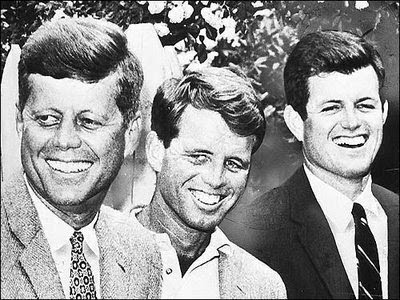 President John F. Kennedy, Senator Robert Kennedy and and Senator Edward Kennedy
This is the cause of my life. It is a key reason that I defied my illness last summer to speak at the Democratic convention in Denver—to support Barack Obama, but also to make sure, as I said, "that we will break the old gridlock and guarantee that every American...will have decent, quality health care as a fundamental right and not just a privilege."
For four decades I have carried this cause—from the floor of the United States Senate to every part of this country. It has never been merely a question of policy; it goes to the heart of my belief in a just society. Now the issue has more meaning for me—and more urgency—than ever before. But it's always been deeply personal, because the importance of health care has been a recurrent lesson throughout most of my 77 years. — Ted Kennedy
The third-ranking Democrat in the House of Representatives on Thursday compared the disruptive protesters at recent health care town halls to people who unleashed dogs and spat on civil rights demonstrators during the 1960s.
By Sam Stein
Huffington Post
August 13, 2009
In an interview with the Huffington Post, Rep. James Clyburn, (D-S.C.), said that there was "absolutely" an analogy to be drawn between the horrid experience that he went through as a civil rights leader and the boisterous conservatives who have disrupted health care forums.
"I have seen this kind of hate before. I have seen this discussion before," he said. "I have seen snarling dogs going after people who were trying to peacefully assemble. I have seen the eyes of people who were being spat upon."
"This is all about activity trying to deny the establishment of a civil right. And I do believe that health care for all is -- a civil right," the House Majority Whip argued. "And I think that is why you see this kind of activity. This is an attempt on the part of some to deny the establishment of a civil right. (click to read rest of article).

The post below was sent to me by a friend. The author, Andrew M. Manis, is associate professor of history at Macon State College in Georgia and wrote this for an editorial in the Macon Telegraph. This courageous author's comments merit national distribution. Therefore, I hope all of my readers will forward it to others. The burden of responsibility for the race problem usually falls disproportionately on blacks. The author takes a different point of view.
By Andrew Manis
For much of the last forty years, ever since America "fixed" its race problem in the Civil Rights and Voting Rights Acts, we white people have been impatient with African Americans who continued to blame race for their difficulties. Often we have heard whites ask, "When are African Americans finally going to get over it?
Now I want to ask:
"When are we White Americans going to get over our ridiculous obsession with skin color?
Recent reports that "Election Spurs Hundreds' of Race Threats, Crimes" should frighten and infuriate every one of us. Having grown up in "Bombingham," Alabama in the 1960s, I remember overhearing an avalanche of comments about what many white classmates and their parents wanted to do to John and Bobby Kennedy and Dr. Martin Luther King, Jr.
Eventually, as you may recall, in all three cases, someone decided to do more than "talk the talk."
Since our recent presidential election, to our eternal shame we are once again hearing the same reprehensible talk I remember from my boyhood.
We white people have controlled political life in the disunited colonies and United States for some 400 years on this continent.
Conservative whites have been in power 28 of the last 40 years. Even during the eight Clinton years, conservatives in Congress blocked most of his agenda and pulled him to the right. Yet never in that period did I read any headlines suggesting that anyone was calling for the assassinations of presidents Nixon, Ford, Reagan, or either of the Bushes. Criticize them, yes.
Call for their impeachment, perhaps. But there were no bounties on their heads. And even when someone did try to kill Ronald Reagan, the perpetrator was non-political mental case who wanted merely to impress Jody Foster.
But elect a liberal who happens to be Black and we're back in the sixties again. At this point in our history, we should be proud that we've proven what conservatives are always saying -- that in America anything is possible, EVEN electing a black man as president.
But instead we now hear that school children from Maine to California are talking about wanting to "assassinate Obama."
Fighting the urge to throw up, I can only ask, "How long?"
How long before we white people realize we can't make our nation, much less the whole world, look like us?
How long until we white people can - once and for all - get over this hell-conceived preoccupation with skin color?
How long until we white people get over the demonic conviction that white skin makes us superior?
How long before we white people get over our bitter resentments about being demoted to the status of equality with non-whites?
How long before we get over our expectations that we should be at the head of the line merely because of our white skin?
How long until we white people end our silence and call out our peers when they share the latest racist jokes in the privacy of our white-only conversations?
I believe in free speech, but how long until we white people start making racist loudmouths as socially uncomfortable as we do flag burners?
How long until we white people will stop insisting that blacks exercise personal responsibility, build strong families, educate themselves enough to edit the Harvard Law Review, and work hard enough to become President of the United States, only to threaten to assassinate them when they do?
How long before we starting "living out the true meaning" of our creeds, both civil and religious, that all men and women are created equal and that "red, brown, yellow, black and white" all are precious in God's sight?
Until this past November 4, I didn't believe this country would ever elect an African American to the presidency. I still don't believe I'll live long enough to see us white people get over our racism problem.
But here's my three-point plan:
First, everyday that Barack Obama lives in the White House that Black Slaves Built, I'm going to pray that God (and the Secret Service) will protect him and his family from us white people.
Second, I'm going to report to the FBI any white person I overhear saying, in seriousness or in jest, anything of a threatening nature about President Obama.
Third, I'm going to pray to live long enough to see America surprise the world once again, when white people can "in spirit and in truth" sing of our damnable color prejudice,
"We HAVE overcome."
It takes a Village to protect our President!!!
 Mug shots of Henry Louis Gates after arrest for disorderly conduct. wbz photo
I am reminded of James Baldwin's book, Nobody Knows My Name, when I think of the thousands of black and brown men who have been the victims of racial profile.
I haven't logged on for more than a month because I got tired of writing on the same old same issues. However, the Henry Louis Gates arrest by the Cambridge police officer deserves a comment.
It is unfortunate that any man, be he white black, brown or yellow, is arrested while trying to enter his own home peacefully. Police officers should exercise restraint when faced with a potentially volatile situation. When Gates showed Officer Crowley his identification, the matter should have ended. However, it gets murky from then on with a disagreement between Officer Crowley's written report and Gates's description of what occurred. If, as the office said, Gates told him "Your mama's outside" (see police report) when he asked him to step outside, the cop should have bitten his lip and left. They are trained to ignore such things. Maybe, on this hot day the officer didn't take kindly to Gates playing the dozens with him. Who knows? We are not mind readers.
I am reminded of James Baldwin's book, Nobody Knows My Name, when I think of the thousands of black and brown men who have been the victims of racial profile. Unlike Skip Gates, these men have no outstanding credentials or media friends to report their arrests on the front page of the New York Times. There is something inherently wrong when the arrest of a nameless Joe Blow ends up only on the police blotter.
I would hope that Skip uses his arrest as an honest way to bring attention to the problem for the thousands of black and brown men whose names are not known by the national media. However, I wouldn't be surprised if the affair ends with the White House beer drinking party hosted by President Obama for Gates and Crowley. President Obama was in hot water for referring to the Cambridge police department as "dumb" without having all the facts. Looking for a way out of the mess that I don't think he should have been involved in from the start, he called Officer Crowley, who suggested he invite him and Gates for a beer at the White House.
Anytime the President speaks on a volatile issue, it takes him off message. The passage of a health care reform bill is more critical to the nation than the arrest of Skip Gates, as President Obama soon learned. Now, I hope the right wingnuts will leave the whole affair alone and the rest of us can get back to health care.
Counterpunch
July 27, 2009
By ISHMAEL REED
Now that Henry Louis Gates’ Jr. has gotten a tiny taste of what “the underclass” undergo each day, do you think that he will go easier on them? Lighten up on the tough love lectures? Even during his encounter with the police, he was given some slack. If a black man in an inner city neighborhood had hesitated to identify himself, or given the police some lip, the police would have called SWAT. When Oscar Grant, an apprentice butcher, talked back to a BART policeman in Oakland, he was shot!
Given the position that Gates has pronounced since the late eighties, if I had been the arresting officer and post-race spokesperson Gates accused me of racism, I would have given him a sample of his own medicine. I would have replied that “race is a social construct”--the line that he and his friends have been pushing over the last couple of decades.
After this experience, will Gates stop attributing the problems of those inner city dwellers to the behavior of “thirty five-year-old grandmothers living in the projects?” (Gates says that when he became a tough lover he was following the example of his mentor Nobel Laureate Wole Soyinka as though his and Soyinka’s situations were the same. As a result of Soyinka’s criticisms of a Nigerian dictator, he was jailed and his life constantly threatened.) Click here to read rest of article.
 Michael Jackson recording We are the world.
There will never be another one like him. As a young boy from a working class family in Gary, Indiana he grabbed our attention like no child singer before him. He was a ground breaker with an extraordinary gift for music. As a singer and dancer, he had no peers. Remember the moonwalk? He had charisma and genuine talent. Long before the modern music studios came into existence, Michael and his brothers of the Jackson Five showed us what real talent is all about. You could hear their beautifully stylized lyrics and you could dance easily to their beat. Their music was sweet, beautiful, and peaceful. It evoked happier times and an optimistic future.
I can see see Michael's fancy footwork now, as I did one night at the Robert F. Kennedy stadium in Washington, DC. It was his "Thriller" concert tour and it was worth every bit of effort it took me to garner tickets very close to the stage for my ten year old son and my twelve year old niece. I was a generation ahead of Michael but he had a way of bridging my generation with my son's. We all had happy feet that night as we danced to Michael's music.
In the days ahead every Tom, Dick and Harry will show up on the front pages of the tabloids to "scandalize" Michael's name. Countless lawsuits will fly as people try to get their claws into his estate. But as for me, I will follow the simple dictum: If you don't have anything good to say about the dead, then say nothing. I am not interested in the rehashing of his sexual and other deviance. Enough has been said about that already.
Let's remember the sheer joy he brought us when he performed the broad range of songs. Also, let us remember the social consciousness he practiced in his early career, as symbolized by the organizing role he played in producing the historic song, "We are the world."
Go in peace young brother. You brought us a lot of joy. Thank you for leaving all of us with a song in our hearts. Your legacy is ensured into future generations.
Rachel Maddow's TV Ratings Shoot Through the Roof
The greatest thing for news junkies is the current line-up on MSNBC. Pundits Chris Matthews, Keith Oblberman have been joined by the super-bright Rhodes Scholar, Rachel Maddow. The girl is smart! She is also courageous and calls a spade a spade. Check her out.
By Jan Frel, AlterNet
Posted on September 18, 2008, Printed on September 19, 2008
http://www.alternet.org/bloggers/www.alternet.org/99378/
The latest cable news ratings show that Rachel Maddow is already ahead of Keith Olbermann and Larry King. Quite a feat in the ultra-competitive TV news environment.
Cable News Ratings for Tuesday, September 16
8PM - P2+ (25-54) (35-64)
The O'Reilly Factor- 3,060,000 viewers (731,000) (1,253,000)
Election Center-1,166,000 viewers (431,000) (576,000)
Countdown w/Keith Olbermann- 1,635,000 viewers (509,000) (771,000)
On the Money--207,000 viewers (65,000) (106,000)
Nancy Grace -1,166,000 viewers (412,000) (618,000)
9 PM - P2+ (25-54) (35-64)
Hannity & Colmes-3,136,000 viewers (716,000) (1,375,000)
Larry King--1,710,000 viewers (496,000) (801,000)
Rachel Maddow Show-1,801,000 viewers (534,000) (872,000)
Business of Innovation--a scratch w/102,000 viewers (a scratch w/42,000) (59,000)
Glenn Beck- 656,000 viewers (211,000) (354,000)
Jan Frel is an AlterNet staff writer.
© 2008 Independent Media Institute. All rights reserved.
View this story online at: http://www.alternet.org/bloggers/www.alternet.org/99378/
McCain's Closing Argument
Washington Post
Columnist
By George F. Will
September 18, 2008
Man is in love and loves what vanishes.
What more is there to say?
-- William Butler Yeats
Conservatives, who reputedly have lumps of coal where their hearts should be, have fallen in love. So have many people who are not doctrinal conservatives. The world is a sweeter place because Sarah Palin has increased the quantity of love, but this is not a reliable foundation for John McCain's campaign.
The tech bubble was followed by the housing bubble, which has been topped by the Palin bubble. Bubbles will always be with us, because irrational exuberance always will be. Its symptom is the assumption that old limits have yielded to undreamed-of possibilities: The Dow will always rise, as will housing prices, and rapture about a running mate can be decisive in a presidential election.
Palin is as bracing as an Arctic breeze and delightfully elicits the condescension of liberals whose enthusiasm for everyday middle-class Americans cannot survive an encounter with one. But the country's romance with her will, as romances do, cool somewhat, and even before November some new fad might distract a nation that loves "American Idol" for the metronomic regularity with which it discovers genius in persons hitherto unsuspected of it.
McCain should, therefore, enunciate a closing argument for his candidacy that goes to fundamentals of governance, concerning which the vice presidency is usually peripheral. His argument should assert the virtues of something that voters, judging by their behavior over time, prefer -- divided government.
The incumbent Republican president's job approval is in the low 30s but is about 10 points higher than that of the Democratic-controlled Congress. The 22nd Amendment will banish the president in January, but Congress will then be even more Democratic than it is now. Does the country really want there to be no check on it? Consider two things that will quickly become law unless McCain is there to veto them or unless -- this is a thin reed on which to depend -- Senate Minority Leader Mitch McConnell has 40 reliable senators to filibuster them to deserved deaths.
The exquisitely misnamed Employee Free Choice Act would strip from workers their right to secret ballots in unionization elections. Instead, unions could use the "card check" system: Once a majority of a company's employees -- each person confronted one on one by a union organizer in an inherently coercive setting -- sign cards expressing consent, the union would be certified as the bargaining agent for all workers. Proving that the law's purpose is less to improve workers' conditions than to capture dues payers for the unions, the law would forbid employers from discouraging unionization by giving "unilateral" -- not negotiated -- improvements in compensation and working conditions.
Unless McCain is president, the government will reinstate the equally misnamed "fairness doctrine." Until Ronald Reagan eliminated it in 1987, that regulation discouraged freewheeling political programming by the threat of litigation over inherently vague standards of "fairness" in presenting "balanced" political views. In 1980 there were fewer than 100 radio talk shows nationwide. Today there are more than 1,400 stations entirely devoted to talk formats. Liberals, not satisfied with their domination of academia, Hollywood and most of the mainstream media, want to kill talk radio, where liberals have been unable to dent conservatives' dominance.
Today, as usual, but perhaps even more so, Americans are in the iron grip of cognitive dissonance. It is a genteel mental disorder afflicting those people -- essentially everybody -- who have contradictory convictions and yearnings. Consider health care. Americans want 2008 medicine at 1958 prices, and universal coverage with undiminished choice -- without mandatory purchases or government interference with choices, including doctor-patient relationships. As usual, neither party completely pleases a majority of voters. That is why 19 of the 31 elections since World War II produced or preserved divided government -- the presidency and at least one chamber of Congress controlled by different parties.
Divided government compels compromises that curb each party's excesses, especially both parties' proclivities for excessive spending when unconstrained by an institution controlled by the other party. William Niskanen, chairman of the libertarian Cato Institute, notes that in the past 50 years, "government spending has increased an average of only 1.73 percent annually during periods of divided government. This number more than triples, to 5.26 percent, for periods of unified government."
By picking Palin, McCain got the country's attention. That is a perishable thing, and before it dissipates, he should show the country his veto pen.
georgewill@washpost.com
Katrina Memories Give Republicans Reason to Worry
September 2, 2008
By Donna Brazile
Roll Call Staff
What a difference three years have made in the federal government’s understanding of how to effectively, efficiently and compassionately deal with a natural disaster like a powerful hurricane hitting our nation’s shores.
While the soap opera aspect of the Republican presidential campaign continues to unfold under the mainstream media radar, I’d rather spend my time and attention while I’m here at the Republican National Convention in St. Paul, Minn., focusing on Hurricane Gustav, whose damaging winds and torrential rainfall are at this very moment wreaking havoc on 300 miles of New Orleans levees still under repair from three years ago.
The Republicans gathered here to nominate Arizona Sen. John McCain and Alaska Gov. Sarah Palin appear hopeful that Hurricane Gustav will wash away our memories of how the Bush White House and Republican-run federal government mishandled Hurricane Katrina.
Three years ago, we as a nation sat transfixed in horror as we watched our fellow Americans either bake or drown while waiting to be rescued from rooftops and the hellholes that were the Superdome and the New Orleans Convention Center. After three years, the images that once burned onto disbelieving retinas continue to sear our hearts and memory.
It is impossible to forget the horrors of that week and the pain and suffering of those left behind and forgotten. Nor should we forget. Americans were left to die. And we watched them being left to die. More than 1,600 folks did die. Dead from their government’s incompetence, they live on in our thoughts and prayers — and votes.
Ironically, almost three years to the day after Hurricane Katrina made landfall and displaced hundreds of thousand of Americans left scattered across the country, the nation is once again reminded that it matters who sits behind the desk in the Oval Office. This time, the federal government is not outsourcing its responsibilities to the state and local government. This time, the executive branch has instructed the federal government to respond.
The 2008 Republican National Convention is still up in the air as organizers continue to scramble to pull together a truncated schedule that allows them to nominate their presidential and vice presidential candidates. The delegates and alternates who have gathered from across America are truly sympathetic to the plight of those who had to evacuate.
Yes, they are deeply concerned. Indeed, as I write this, they are looking for ways to help the GOP delegates from areas threatened by Hurricane Gustav get home safely to assess the damage and begin the repairing process.
No doubt McCain is painfully aware that all eyes will be on how his party and its leader will treat this latest attack on New Orleans and its Gulf Coast neighbors. No doubt he remembers where he was when Katrina hit landfall three years ago: in Arizona with President Bush celebrating his birthday. Like the president, who is holding fort in the emergency command centers in Texas, McCain is aware that the American people are watching. Pictures matter, but so do public policies.
We continue to lack public policies that will help people with houses damaged from Gustav (and Katrina and Rita, for that matter) repair their homes and rebuild their lives. Tens of thousands of Americans remain exiled from their homes.
I met one such survivor here at the Republican convention. She’s working as a top chef at one of the major hotels. Like me, she was born at Charity Hospital in New Orleans. When raging storm waters flooded her home, she fled to safety in St. Paul.
While watching the TV set near the hotel dining room with her, I watch as tears stream down her face. I promise her things will be better this time. I tell her the government will get everyone out safely and, later, help them get back home.
“I hope so,” she tells me. “I still am here and cannot go back.”
Aletha is not alone. So many thousands of people, including my own siblings, must answer many questions after this storm has passed. Can they go back and rebuild their lives? Can they afford to replace the roofs, windows and the other broken bits of their homes destroyed by Gustav? And what about the schools, the roads, the bridges and the hospitals? Will they also be rebuilt? When?
Soon, we can only hope. Just as we can only hope that the Republicans gathered here in Minnesota this week will not forget Gustav’s victims after they return home and it’s back to politics as usual.
McCain faces a unique challenge this week. He must not only distance himself from the uncompassionate and incompetent response of the Bush administration concerning Hurricane Katrina; he must also distance himself from his own hapless and heartless response.
After all, McCain voted against the emergency funding bill, including $28 billion for hurricane relief.
McCain voted against giving Katrina victims five months of Medicaid services.
He voted — twice — against establishing a commission to study the response to Hurricane Katrina.
And he opposed granting financial relief to families affected by Hurricane Katrina.
McCain talks about putting the country first. I support those who talk about putting the American people first.
How McCain reacts to and deals with these two latest events — Hurricane Gustav and Hurricane Palin (the soap opera involving the politically naive rookie he chose to be his running mate) — will demonstrate to the American people the kind of judgment and leadership they can expect from him as president. Along with the rest of America, the good and beleaguered folks of the Gulf Coast states will be watching closely. And, come Election Day, they will not forget.
Donna Brazile, the campaign manager for Democratic presidential nominee Al Gore in 2000, runs her own grass-roots political consulting firm.
Official 2008 Obama/McCain Presidential Debate Schedule
The official Presidential debate schedule for John McCain and Barack Obama has been finalized and released in a joint statement from each campaign. There will also be a vice presidential debate as well.
Here is the full official debate schedule:
Forums:
August 16, 2008: Video: Saddleback Civil Forum with Rick Warren at Saddleback Church, Lake Forest California
(Not part of the official sanctioned schedule but both candidates attended)
Debates:
-2008-
September 26, 2008: Presidential debate with domestic policy focus, University of Mississippi, Oxford, MS
October 2, 2008: Vice Presidential debate, Washington University, St. Louis, MO
October 7, 2008: Presidential debate in a town hall format, Belmont University, Nashville, TN
October 15, 2008: Presidential debate with foreign policy focus, Hofstra University, Hempstead, NY
--------------------------------------------------------------------------------
Here is a break down of what each debate will consist of:
1. First Presidential Debate: – Date: September 26 – Site: University of Mississippi – Topic: Foreign Policy & National Security – Moderator: Jim Lehrer – Staging: Podium debate – Answer Format: The debate will be broken into nine, 9-minute segments. The moderator will introduce a topic and allow each candidate 2 minutes to comment. After these initial answers, the moderator will facilitate an open discussion of the topic for the remaining 5 minutes, ensuring that both candidates receive an equal amount of time to comment
2. Vice Presidential Debate – Date: October 2nd – Site: Washington University (St. Louis) – Moderator: Gwen Ifill – Staging/Answer Format: To be resolved after both parties’ Vice Presidential nominees are selected.
3. Second Presidential Debate – Date: October 7 – Site: Belmont University – Moderator: Tom Brokaw – Staging: Town Hall debate – Format: The moderator will call on members of the audience (and draw questions from the internet). Each candidate will have 2 minutes to respond to each question. Following those initial answers, the moderator will invite the candidates to respond to the previous answers, for a total of 1 minute, ensuring that both candidates receive an equal amount of time to comment. In the spirit of the Town Hall, all questions will come from the audience (or internet), and not the moderator.
4. Third Presidential Debate – Date: October 15 – Site: Hofstra University – Topic: Domestic and Economic policy – Moderator: Bob Schieffer – Staging: Candidates will be seated at a table – Answer Format: Same as First Presidential Debate – Closing Statements: At the end of this debate (only) each candidate shall have the opportunity for a 90 second closing statement.
--------------------------------------------------------------------------------
All four debates will begin at 9pm ET, and last for 90 minutes. Both campaigns also agreed to accept the CPD’s participation rules for third-party candidate participation.
All 4 debates will be broadcast on the major broadcast networks, including CBS, NBC, ABC, and FOX. They will also be aired on cable news channels such as CNN, MSNBC, Fox News, and C-SPAN.
We will have full videos of each debate uploaded once they air.
Palin's Problem
By Charles Krauthammer
Friday, September 5, 2008
"There are two questions we will never have to ask ourselves, 'Who is this man?' and 'Can we trust this man with the presidency?' "
-- Fred Thompson on John McCain, Sept. 2
This was the most effective line of the entire Republican convention: a ringing affirmation of John McCain's authenticity and a not-so-subtle indictment of Barack Obama's insubstantiality. What's left of this line of argument, however, after John McCain picks Sarah Palin for vice president?
Palin is an admirable and formidable woman. She has energized the Republican base and single-handedly unified the Republican convention behind McCain. She performed spectacularly in her acceptance speech. Nonetheless, the choice of Palin remains deeply problematic.
It's clear that McCain picked her because he had decided that he needed a game-changer. But why? He'd closed the gap in the polls with Obama. True, that had more to do with Obama sagging than McCain gaining. But what's the difference? You win either way.
Obama was sagging because of missteps that reflected the fundamental weakness of his candidacy. Which suggested McCain's strategy: Make this a referendum on Obama, surely the least experienced, least qualified, least prepared presidential nominee in living memory.
Palin fatally undermines this entire line of attack. This is through no fault of her own. It is simply a function of her rookie status. The vice president's only constitutional duty of any significance is to become president at a moment's notice. Palin is not ready. Nor is Obama. But with Palin, the case against Obama evaporates.
So why did McCain do it? He figured it's a Democratic year. The Republican brand is deeply tarnished. The opposition is running on "change" in a change election. So McCain gambled that he could steal the change issue for himself -- a crazy brave, characteristically reckless, inconceivably difficult maneuver -- by picking an authentically independent, tough-minded reformer. With Palin, he doubles down on change.
The problem is the inherent oddity of the incumbent party running on change. Here were Republicans -- the party that controlled the White House for eight years and both houses of Congress for five -- wildly cheering the promise to take on Washington. I don't mean to be impolite, but who's controlled Washington this decade?
Moreover, McCain was giving up his home turf of readiness to challenge Obama on his home turf of change. Can that possibly be pulled off? The calculation was to choose demographics over thematics. Palin's selection negates the theme of readiness. But she does bring important constituencies. She has the unique potential of energizing the base while at the same time appealing to independents.
This is unusual. Normally the wing-nut candidate alienates the center. Palin promises a twofer because of her potential appeal to the swing-state Reagan Democrats that Hillary Clinton carried in the primaries. Not for reasons of gender -- Clinton didn't carry those voters because she was a woman -- but because more culturally conservative working-class whites might find affinity with Palin's small-town, middle/frontier American narrative and values.
The gamble is enormous. In a stroke, McCain gratuitously forfeited his most powerful argument against Obama. And this was even before Palin's inevitable liabilities began to pile up -- inevitable because any previously unvetted neophyte has "issues." The kid. The state trooper investigation. And worst, the paucity of any Palin record or expressed conviction on the major issues of our time.McCain has one hope. It is suggested by the strength of Palin's performance Wednesday night. In a year of compounding ironies, the McCain candidacy could be saved, and the Palin choice vindicated, by one thing: Palin pulls an Obama.
Obama showed that star power can trump the gravest of biographical liabilities. The sheer elegance, intelligence and power of his public presence have muted the uneasy feeling about his unreadiness. Palin does not reach Obama's mesmeric level. Her appeal is far more earthy, workmanlike and direct. Yet she managed to banish a week's worth of unfriendly media scrutiny and self-inflicted personal liabilities with a single triumphant speech.
Now, Obama had 19 months to make his magic obscure his thinness. Palin has nine weeks. Nevertheless, if she too can neutralize unreadiness with star power, then the demographic advantages she brings McCain -- appeal to the base and to Reagan Democrats -- coupled with her contribution to the reform theme, might just pay off. The question is: Can she do the magic -- unteleprompted extemporaneous magic, from now on -- for the next nine weeks?
letters@charleskrauthammer.com
National Election News from The Miss America Organization
This has to be a first: the Miss America Paegant issued a press release on the VP stakes.
McCain Names Former Miss Alaska Contestant as Running Mate
We are pleased to announce that former Miss Alaska contestant, Sarah Heath Palin, has just been named as John McCain’s vice-presidential candidate on the Republican ticket. In 1984, Palin was chosen as Miss Wasilla and went on to become the first runner-up in the Miss Alaska Pageant and received the Miss Congeniality award the same year. Her husband, Todd Palin was a judge in the 2008 Miss Alaska Pageant.
Congratulations on this exciting news for the Miss Alaska Organization!
The Oprah-fication of Michelle Obama
August 26, 2008
New York Times
By The Editorial Board
If Barack Obama is elected president, a good chunk of credit should go to Oprah Winfrey. Her early and enthusiastic endorsement of Senator Obama – and her heavily attended appearances with him in Iowa and South Carolina – played a big role in winning over bit parts of Middle America to the Obama cause.
Ms. Winfrey has since faded into the background of the campaign, but her impact persists – perhaps nowhere more than in Monday night’s speech by Michelle Obama.
It was one of the most important speeches of the convention – far more so than the crowd-pleasing valedictory of Senator Edward M. Kennedy the same night. The campaign still has a significant selling job to do with Michelle Obama, who has been repeatedly baited by Republicans as angry, hostile to whites, and un-American.
Ms. Obama did an admirable job of turning back the right-wing assault – and she did it with an Oprah script:
Sentiment Is More Important Than Politics – One reason Ms. Winfrey’s endorsement of Senator Obama was so unusual is that with few exceptions, she has stayed away from politics. What she sells on her television show and in her magazine, for the most part, are sentiment, good feeling, and self-improvement.
In her speech, Ms. Obama made the major theme family – a very sweet version of family. She began with her brother, whom she described as “watching over me.” She moved on to the sustaining love of her mother and her late father, and then to her husband and children.
Doting wife and mother may be the role Americans have come to expect from their first ladies, but it was laid on heavily.
Ms. Obama has always talked a good deal about her family, but she has done so with a refreshing tartness. It was not love at first sight with her husband. When he first began asking her out, she has said, she refused, concerned it would interfere with their work.
She has talked about being the taskmaster in the Obama household, doling out assignments and keeping the girls on the straight and narrow. Those more piquant notes were left out Monday night.
Life is About Triumphing Over Adversity – Ms. Winfrey, who has spoken often of being a childhood sexual abuse victim, has emphasized the importance of rising above difficult circumstances. It is one of her favorite themes in life and literature.
Ms. Obama has a lot to be proud of, and her speech emphasized the struggle. She described herself as “raised on the South Side of Chicago by a father who was a blue-collar city worker.” Perhaps since her own rise has been so steady, she recounted her father’s difficulties in detail. He battled multiple sclerosis in his 30s, she said, struggled to button his shirt, and used “two canes to get himself across the room to give my mom a kiss.”
Keeping a Gratitude Journal – Ms. Winfrey has had a lot to be unhappy about over the years, from the early abuse, to racism during her childhood in the Jim Crow South, to obstacles of more recent vintage. Her advice has always been not to dwell on the negative, but to keep a journal of everything one is grateful for.
So it was with Ms. Obama Monday night. The comments she has at times made about America’s flaws - refreshingly candid perhaps, but also politically maladroit - were deleted. In their place was a whole section on “Why I Love This Country.”
The “Oprah Moment” — Ms. Obama’s speech ended with an “Oprah moment.” As a surprise — and as those free-car winners can attest, Ms. Winfrey loves surprises — Senator Obama appeared from a remote location (in a swing state), and bantered with the family. “How do you think Mommy did?” It was quintessential Oprah.
There is, of course, a reason Ms. Winfrey is so popular. Her story lines are ones that resonate strongly with many Americans – and non-Americans. Through those themes, Ms. Winfrey may do as much for Michelle Obama as she has already done for Barack Obama.
Too Much of a Bad Thing
August 24, 2008
Op-Ed Columnist
New York Times
By MAUREEN DOWD
WASHINGTON
My mom did not approve of men who cheated on their wives. She called them “long-tailed rats.”
During the 2000 race, she listened to news reports about John McCain confessing to dalliances that caused his first marriage to fall apart after he came back from his stint as a P.O.W. in Vietnam.
I figured, given her stringent moral standards, that her great affection for McCain would be dimmed.
“So,” I asked her, “what do you think of that?”
“A man who lives in a box for five years can do whatever he wants,” she replied matter-of-factly.
I was startled, but it brought home to me what a powerful get-out-of-jail-free card McCain had earned by not getting out of jail free.
His brutal hiatus in the Hanoi Hilton is one of the most stirring narratives ever told on the presidential trail — a trail full of heroic war stories. It created an enormous credit line of good will with the American people. It also allowed McCain, the errant son of the admiral who was the commander of U.S. forces in the Pacific during Vietnam — his jailers dubbed McCain the “Crown Prince” — to give himself some credit.
“He has been preoccupied with escaping the shadow of his father and establishing his own image and identity in the eyes of others,” read a psychiatric evaluation in his medical files. “He feels his experiences and performance as a P.O.W. have finally permitted this to happen.”
The ordeal also gave a more sympathetic cast to his carousing. As Robert Timberg wrote in “John McCain: An American Odyssey,” “What is true is that a number of P.O.W.’s, in those first few years after their release, often acted erratically, their lives pockmarked by drastic mood swings and uncharacteristic behavior before achieving a more mellow equilibrium.” Timberg said Hemingway’s line that people were stronger in the broken places was not always right.
So it’s hard to believe that John McCain is now in danger of exceeding his credit limit on the equivalent of an American Express black card. His campaign is cheapening his greatest strength — and making a mockery of his already dubious claim that he’s reticent to talk about his P.O.W. experience — by flashing the P.O.W. card to rebut any criticism, no matter how unrelated. The captivity is already amply displayed in posters and TV advertisements.
The Rev. Kirbyjon Caldwell, the pastor who married Jenna Bush and who is part of a new Christian-based political action committee supporting Obama, recently criticized the joke McCain made at the Sturgis Motorcycle Rally encouraging Cindy to enter the topless Miss Buffalo Chip contest. The McCain spokesman Brian Rogers brought out the bottomless excuse, responding with asperity that McCain’s character had been “tested and forged in ways few can fathom.”
When the Obama crowd was miffed to learn that McCain was in a motorcade rather than in a “cone of silence” while Obama was being questioned by Rick Warren, Nicolle Wallace of the McCain camp retorted, “The insinuation from the Obama campaign that John McCain, a former prisoner of war, cheated is outrageous.”
When Obama chaffed McCain for forgetting how many houses he owns, Rogers huffed, “This is a guy who lived in one house for five and a half years — in prison.”
As Sam Stein notes in The Huffington Post: “The senator has even brought his military record into discussion of his music tastes. Explaining that his favorite song was ‘Dancing Queen’ by Abba, he offered that his knowledge of music ‘stopped evolving when his plane intercepted a surface-to-air missile.’ ‘Dancing Queen,’ however, was produced in 1975, eight years after McCain’s plane was shot down.”
The Kerry Swift-boat attacks in 2004 struck down the off-limits signs that were traditionally on a candidate’s military service. Many Democrats are willing to repay the favor, and Republicans clearly no longer see war medals as sacrosanct.
In a radio interview last week, Representative Terry Everett, an Alabama Republican, let loose with a barrage at the Democrat John Murtha, a decorated Vietnam War veteran who is the head of the House defense appropriations subcommittee, calling him “cut-and-run John Murtha” and an “idiot.”
“And don’t talk to me about him being an ex-marine,” Everett said. “Lord, that was 40 years ago. A lot of stuff can happen in 40 years.”
The real danger to the McCain crew in overusing the P.O.W. line so much that it’s a punch line is that it will give Obama an opening for critical questions:
While McCain’s experience was heroic, did it create a worldview incapable of anticipating the limits to U.S. military power in Iraq? Did he fail to absorb the lessons of Vietnam, so that he is doomed to always want to refight it? Did his captivity inform a search-and-destroy, shoot-first-ask-questions-later, “We are all Georgians,” mentality?
Toby Keith said he likes Barack Obama
LOS ANGELES — Barack Obama is getting praise from Nashville, courtesy of one big, patriotic country star.
Toby Keith, perhaps best known to non-country audiences for his post-Sept. 11 song "Courtesy of the Red, White and Blue," says he's a Democrat, and was impressed by the senator from Illinois.
Keith has said in the past that the 2002 song — which included lines aimed at the Taliban like "we lit up your world like the Fourth of July" — was more patriotic than pro-war.
Asked while promoting his new movie "Beer For My Horses" about the role of patriotism in the current presidential election, Keith replied: "There's a big part of America that really believes that there is a war on terrorism, and that we need to finish up.
"So I thought it was beautiful the other day when Obama went to Afghanistan and got educated about Afghanistan and Iraq. He came back and said some really nice things.
"So as far as leadership and patriotism goes, I think it's really important that those things have to take place. And I think he's the best Democratic candidate we've had since Bill Clinton. And that's coming from a Democrat."
Copyright 2008 The Associated Press. All rights reserved. This material may not be published, broadcast, rewritten or redistributed.
Par for Mr. Corsi
An expert at misrepresentation takes on Barack Obama.
Washington Post
Editorial
Friday, August 15, 2008
THERE'S A cottage industry in books about Barack Obama; by one count, more than 20 are just out or are in the works. But few debut in the No. 1 spot on the New York Times bestseller list, as Jerome R. Corsi's "The Obama Nation" will do among nonfiction hardcover titles this week. Unfortunately but unsurprisingly, given his earlier hit job on the last Democratic nominee, Mr. Corsi's latest is rife with inaccuracies and innuendo. If the fundamental smear of "Unfit for Command" was that John F. Kerry was no war hero, the insinuation of Mr. Corsi's latest is that Mr. Obama is a closet Muslim and militant, black activist drug-user.
"The Obama Nation" -- the ungainly play on words (abomination, get it?) is "fully intended," the author tells us -- reprises the Corsi method. Mr. Corsi boasts that "I fully document all arguments and contentions I make, extensively footnoting all references" and asserts that "my fundamental opposition to Obama's presidential candidacy involves public policy differences." But footnoting to a discredited blog item does not constitute careful scholarship, and the bulk of Mr. Corsi's book has nothing to do with issues.
He gets facts wrong, from the date of Mr. Obama's marriage to whether he dedicated his autobiography to his family (he did) to whether he revealed that he took his future wife on his second trip to Kenya (he did.) He makes offensive statements: "The sexual attraction of his mother to her African husband jumps out from the page."
When facts are lacking, Mr. Corsi makes his point by suggestive questions. Noting that Life magazine could find no record of an article that Mr. Obama remembered reading as a child about a black man who tried to lighten his skin, Mr. Corsi asks, "How much more imagining, hypothetical lying, or just plain lying is Obama capable of doing?" When facts are present, he twists them to make Mr. Obama bad.
Mr. Corsi's discussion of Mr. Obama's drug use -- disclosed by Mr. Obama in his autobiography -- manages to combine a few of these techniques. "Still, Obama has yet to answer questions whether he ever dealt drugs, or if he stopped using marijuana and cocaine completely in college, or whether his drug usage extended into his law school days or beyond. Did Obama ever use drugs in his days as a community organizer in Chicago, or when he was a state senator from Illinois? How about in the U.S. Senate?" In fact, Mr. Obama has said that he stopped using drugs when he was 20. Mr. Corsi is similarly misleading about Mr. Obama's religious background, questioning his claim to be Christian. "Obama had to know that running for political office, even state office, would be much more difficult to do if voters suspected he was a Muslim," Corsi writes. "Yet once Obama became a member of Trinity, he had proof he was a Christian, as he professed to be."
Mr. Corsi has dismissed criticisms of his book as "nit-picking," an odd defense coming from an author happy to inflate any possible omission into a full-blown evasion. Mary Matalin, the Republican political strategist who heads Threshold Editions, the Simon and Schuster division that published "The Obama Nation," described the book to the New York Times as "a piece of scholarship, and a good one at that." That would not be our description.
When political hacks edit books.
chatterbox
Mary Matalin, Publisher
By Timothy Noah
Posted Wednesday, Aug. 13, 2008, at 7:04 PM ET
Jerome R. Corsi has written a book about Barack Obama cleverly titled The Obama Nation: Leftist Politics and the Cult of Personality. The book is published by Threshold Editions, Mary Matalin's imprint at Simon & Schuster. It "was not designed to be, and does not set out to be, a political book," Matalin sniffed to Jim Rutenberg and Julie Bosman of the New York Times. Rather, it is "a piece of scholarship, and a good one at that." Corsi holds a doctorate in government from Harvard University, and the book's cover highlights Corsi's academic credential with the byline "Jerome R. Corsi, Ph.d."
But Corsi, a staff reporter for the hard-right World Net Daily and co-author of Unfit for Command: Swift Boat Veterans Speak Out Against John Kerry, a 2004 hit job published by the hard-right Regnery, maintains his scholarly posture with some difficulty. In his off-hours, Corsi calls Arabs "ragheads" and Bill Clinton an "anti-American communist" on Internet message boards. Susan Estrich is "Susan Estrogen" and Katie Couric is "Little Katie Communist." In the past, Corsi's fellow conservative, Debbie Schlussel, has even accused Corsi of plagiarism (though, to be fair, this looks to me more like garden-variety theft, i.e., taking an idea and some facts from another columnist without extending the usual courtesy of a citation; a minor offense in journalism, if not in academia).
Why did Corsi write The Obama Nation? Was it in disinterested pursuit of scholarly truth? Er, not exactly. "The goal is to defeat Obama," he told the Times. "I don't want Obama to be in office."
I haven't read The Obama Nation. But both the Times and Media Matters for America, a liberal watchdog Web site (and the source of my above links to "ragheads," etc.), cite multiple errors in the book. Ordinarily, when an author or an editor discovers errors in a book's text, he or she arranges to correct them in the next printing. I've done this myself. But neither Corsi nor Matalin responded to e-mails from me asking whether they intended to correct any errors in The Obama Nation—it would be a miracle if there were none. In the Times, Corsi brushed aside the Media Matters critique because of its politics. Now, I yield to no one in my skepticism regarding the veracity of Media Matters' chief executive officer, the former right-wing hit man David Brock. But Media Matters operates on the principle of transparency, providing links and video clips necessary to assess its claims of falsehood. Sometimes the claims hold up; sometimes they seem like a reach. Most of its findings concerning The Obama Nation are unassailable. For instance, Obama either has or hasn't stated publicly when he stopped using marijuana and cocaine. According to Corsi, he hasn't. According to Obama's memoir Dreams From My Father he has. "I stopped getting high" when he was an undergraduate at Columbia, Obama writes. The Times further notes that in 2003, Obama told the State Journal-Register of Springfield, Ill., in response to a question about drug use, "I haven't done anything since I was 20 years old." When the Times confronted Corsi with this information, he changed the subject from his book's obvious error to what he deems the unreliability of self-reporting on matters of drug use. Which, of course, was entirely beside the point.
All this raises the question of whether the world of "conservative" publishing, which includes not only Matalin's imprint at Simon & Schuster but also Random House's Crown Forum and Penguin Group USA's Sentinel, aspires even to the standards of the nonideological (or what conservatives call the "liberal") publishing establishment, which are nothing to write home about. What I've learned about The Obama Nation suggests it does not. What the hell is Mary Matalin doing running a publishing imprint in the first place? She is a professional propagandist, a political operative who learned her craft at the feet not of Maxwell Perkins but of Lee Atwater. Truth is not what she's about; campaigns are, and for Matalin, The Obama Nation would appear to be just another campaign. This isn't to say that, through her Threshold imprint, Matalin is subverting Simon & Schuster's pursuit of profit to partisan ends. Quite the contrary. Simon & Schuster and the other big publishing houses have started conservative imprints, at arms' length and with noses held, because they recognize them to be a gold mine. The Obama Nation, the Times reports, will debut on its best-seller list this Sunday at No. 1. But part of the deal, clearly, is that conservative imprints aren't required to adhere to the same standards of truth as the grown-up divisions. If an Erwin Glikes or even an Adam Bellow is available to edit your conservative fall list, fine. But in a pinch, a Mary Matalin will do. It's what George W. Bush memorably dubbed the soft bigotry of low expectations. The conservative movement has won the publishing houses' attention but not their respect. Does it even care?
Timothy Noah is a senior writer at Slate.
Article URL: http://www.slate.com/id/2197432/
Copyright 2008 Washingtonpost.Newsweek Interactive Co. LLC
Obama as Incumbent
Washington Post
Columnist
By E. J. Dionne Jr.
Monday, August 11, 2008
The core strategy of John McCain's campaign is to turn Barack Obama into the incumbent, the man who is too familiar yet still mysterious.
The effort reflects one of the most remarkable aspects of the 2008 campaign: Obama has turned himself into the central figure in American politics. That is an extraordinary achievement, but it comes at a price.
One cost was measured by a Pew Research Center study released last week that found that 48 percent of all those surveyed -- and 51 percent of the political independents -- said they had heard "too much" about Obama. Only 26 percent (and 28 percent of independents) said that about McCain.
This is understandable: From mid- to late-February until only the past week or so, Obama had received far more media attention than McCain, according to the Campaign Coverage Index produced by Pew's Project for Excellence in Journalism.
Obama's centrality has created an odd dynamic. The most important influences on the campaign are President Bush's unpopularity and the collapse of public sympathy for the Republican Party, meaning that a majority is inclined to vote for the Democratic nominee unless he is rendered unacceptable.
But with Bush fading into the background, McCain's campaign has been more about Obama than about himself. In recent weeks, McCain's advertising tossed one charge after another at the man painted serially as "the biggest celebrity in the world," "Dr. No" and "The One." McCain's attacks, which helped build Obama fatigue, continued over the weekend.
Yet Obama has absorbed the assaults and headed to his holiday in Hawaii holding an advantage of four to six percentage points -- roughly the same margin he has enjoyed all summer. This led political strategists in both parties with whom I spoke in recent days to challenge the conventional wisdom of an Obama campaign that is "underperforming."
Obama has been criticized for not responding quickly enough to the McCain offensive. But the past two weeks have solidified voters' perceptions, measured in recent polls, that the Republican campaign is far more negative than Obama's. This opens space for Obama to respond forcefully to McCain without being accused of initiating the attacks.
Moreover, a candidate who spends all his time defining his opponent has not spent much time defining himself. McCain is living off his maverick image. This has fed voter perceptions that he is moderate and independent, allowing him to run more competitively with Obama than any of McCain's primary opponents could have.
Despite McCain's longevity in the public eye, though, a CBS News poll last week found a third of voters still undecided in their opinion of McCain or saying they didn't know enough to form one. (Roughly the same proportion said this about Obama.)
This leaves room for Democrats to define McCain as a conventional conservative and a Bush supporter. And some Republicans wonder if McCain, by absorbing so many Bush operatives into his campaign, may have limited his maneuvering room to declare his independence from an unpopular president.
In the past two weeks, McCain has succeeded in narrowing the economic discussion to energy and oil drilling, forcing Obama to respond defensively. But "drill, drill, drill" is not a slogan that can carry McCain through November, given the range of the electorate's economic discontents.
There is a certain shrewdness to the McCain campaign's effort to turn Obama's strengths -- the energy he excites in crowds, the historic nature of his candidacy and the interest he has created overseas -- into weaknesses.
"They're trying to make lemonade out of a lemon," said one Democratic strategist who is not working for the Obama campaign. "It's not a bad thing to do, but it's a sign of weakness."
Thus the effort to turn Obama into the incumbent. McCain loses if the race becomes a referendum on Bush. He is running behind on most issues. And he has yet to generate the commitment among those who say they're for him that Obama has inspired among his own supporters.
The one contest McCain can win is an election about Obama. Paradoxically, Obama's imperative at his convention is to reassure voters about who he is while also moving the spotlight off himself.
postchat@aol.com
Political Wives Enabling Immoral Behavior
By Sally Quinn
Washington Post Reporter
I just want to smack him across the puss, as my Savannah-born mother used to say. I want to smack him across that pretty puss, those pretty eyelashes, that pretty hair. I want to shake him and knock his pretty head against the wall.
At first that was all I could think of when I heard about John Edwards' confession. Because all the words about him had already been said. We've been through this so many times there's almost nothing left to say. Sure, they are all "lyin', cheatin', no-good hypocrites!" as the New York Post headline screamed. So what else is new?
The details are, of course, always different. In this case, Edwards says he wasn't in love with the other woman, it ended in 2006, the baby is not his, he told his wife every painful detail, she forgave him and anyway she was in remission from cancer so it wasn't really all that bad. Frankly, though, I don't see what John Edwards did as being that different from what any of the other men in power -- Bill Clinton, Eliot Spitzer, etc. -- did. I don't see that the moral issues are all that different either. Like the others, Edwards and his wife pretended they were one big happy family, and like the others he lied to his family, the staff and the press. But we're all so cynical now that we don't believe a word they say and I think most Americans are so scandal fatigued that they just shrug them off.
Let's try to give John Edwards the benefit of the doubt for a moment. He lost a son in a tragic automobile accident. His wife developed breast cancer shortly before he lost the exhausting campaign for vice president. The cancer returned. It is inoperable. He has three children to whom he has to give moral support while his wife has been sick and he was running for president at his wife's insistence. That's a lot to deal with. I've had a number of friends die of cancer and often, discreetly, their spouses have turned to someone else for comfort and support, especially if the disease is drawn out. People have not judged them harshly. None of that excuses his behavior but at least it partially explains it. Even if he is a narcissistic, self centered, lyin', cheatin', no-good, hypocritical egomaniac which of course he is.
That, however is not what is interesting about this story. What is interesting here is Elizabeth Edwards.
This is the thing that is driving me crazy. The wives. The enabling wives. Nobody has more respect for Elizabeth Edwards than I do. First of all, any woman who has lost a child gets a pass for life from me. Nothing could be more horrible. Not only that, she is brilliant, clever, capable, decent and courageous. She has battled cancer, taken care of her family and been a loyal campaigner for her husband. The grief she has gone through, having lost a child and knowing she may leave her other three motherless must be unbearable.
The problem is, SHE LET HIM DO IT. She not only agreed to his run for the presidency, she encouraged him to do it, knowing the toll it would take on the family given her health problems. But, worse, she let him do it knowing that he had had an affair. What on earth was she thinking? She said in the Daily Kos, "This was our private matter, and I frankly wanted it to be private because as painful as it was I did not want to have to play it out on a public stage as well." I'm sorry but it was not a private matter. Not when you are running for president. The press would surely have left him alone had he not run. The mainstream press left him alone while he was running, but if he had won the primaries she had to know it surely would have come out. It always comes out. Repeat... it always comes out.
Not only did she allow him to run, exposing herself and her children to the pain and humiliation that would inevitably come, she could have allowed him to destroy the Democratic party in the process. This man was running for the President of the United States on a lie and she knew it. If he had not entered the race it could have changed the outcome of the primary. And what if he had won the primary? Think of the people they betrayed -- yes, THEY. They betrayed their devoted staff, the supporters who sent in millions of dollars, the taxpayers who supplied Secret Service protection (I want my money back) , their party and their country. She stood by and let him lie and lie and lie.
This simply can't go on. These women, these political spouses have to stop enabling their husbands to behave like this. Because as long as they do the men will continue to cheat, lie and betray. As long as they believe there will be no consequences (and by their wives tacit support they begin to believe it), what is there to stop them?
This kind of thing hurts everybody. Most importantly it hurts women. It paints all of us as pathetic victims, or potential ones in any case. Every time one of these guys goes off the reservation it creates the perception that it's OK, that that's what men do and the women should just shut up, put on a brave face and support them.
Yes, I want to smack John Edwards across the puss. But more than that I want Elizabeth Edwards to do it for me. Not just for me but for all of us.
Washington Post journalist, author and Washington DC insider, Sally Quinn founded and co-moderates On Faith, a blog from the Washington Post and Newsweek. Co-moderated by Newsweek editor and bestselling author Jon Meacham and hosted by a panel of renowned religious scholars of all denominations, On Faith is the first worldwide, interactive discussion about religion and its impact on global life.
Stalking, Sniffing, Swooning
July 27, 2008
New York Times
OP-ED COLUMNIST
By MAUREEN DOWD
LONDON
It could have been a French movie.
Passing acquaintances collide in a moment of transcendent passion. They look at each other shyly and touch tenderly during their Paris cinq à sept, exchange some existential thoughts under exquisite chandeliers, and — tant pis — go their separate ways.
Sarko, back to Carla Bruni. Obama, forward to Gordon Brown. A Man and a Man. All it needed was a lush score and Claude Lelouch.
Even for Sarkozy the American, who loves everything in our culture from Sylvester Stallone to Gloria Gaynor, it was a wild gush over a new Washington crush.
Sarko is right and Barack is left. One had a Jewish grandfather, the other a Muslim one. The French president is a frenetic bumper car; the Illinois senator is, as he said of the king of Jordan’s Mercedes 600, “a smooth ride.”
But the son of a Hungarian, who picked a lock to break into the French ruling class, embraced a fellow outsider and child of an immigrant who had also busted into the political aristocracy with a foreign-sounding name.
After 200,000 people thronged to see Obama at the Victory Column in Berlin, christening him “Redeemer” and “Savior,” it turned out Sarko was also Obamarized, as the Germans were calling the mesmerizing effect.
“You must want a cigarette after that,” I teased the candidate after the amorous joint press conference, as he flew from Paris to London for the finale of his grand tour.
“I think we could work well together,” he said of Sarko, smiling broadly.
He did not get to meet his fan, Carla Bruni. “She wasn’t there,” he said. “Which I think disappointed all my staff. That was the only thing they were really interested in.”
He admitted showing “extraordinarily poor judgment” in leaving Paris after only a few hours. Watching Paris recede from behind the frosted glass of his limo was “a pretty good metaphor” for how constricted his life has become, he said, compared with his student days tramping around Europe with “a feeling of complete freedom.”
“But the flip side is that I deeply enjoy the work,” he said, “so it’s a trade-off.”
How do you go back to the Iowa farm after you’ve seen Paree?
“One of the values of this trip for me was to remind me of what this campaign should be about,” he said. “It’s so easy to get sucked into day-to-day, tit-for-tat thinking, finding some clever retort for whatever comment your opponent made. And then I think I’m not doing my job, which should be to raise up some big important issues.”
I asked how his “Citizen of the World” tour will go down in Steubenville, Ohio.
“There will probably be some backlash,” he said. “I’m a big believer that if something’s good then there’s a bad to it, and vice versa. We had a good week. That always inspires the press to knock me down a peg.”
He thinks most people recognize that “there is a concrete advantage to not only foreign leaders, but foreign populations liking the American president, because it makes it easier for Sarkozy to send troops into Afghanistan if his voting base likes the United States.”
How does he like the McCain camp mocking him as “The One”?
“Even if you start believing your own hype, which I rarely do, things’ll turn on you pretty quick anyway,” he said. “I have a fairly steady temperament that has at times been interpreted as, ‘Oh, he’s sort of too cool.’ But it’s not real.”
Obama kept his cool through a week where he was treated as a cross between the Dalai Lama and Johnny Depp.
A private prayer he left in the holy Western Wall in Jerusalem was snatched out by a student at a Jewish seminary and published in a local newspaper. In Berlin, the tabloid Bild sent an attractive blonde reporter to stalk Obama at the Ritz-Carlton gym as he exercised with his body man, Reggie Love. She then wrote a tell-all, enthusing, “I’m getting hot, and not from the workout,” and concluding, “What a man.”
Obama marveled: “I’m just realizing what I’ve got to become accustomed to. The fact that I was played like that at the gym. Do you remember ‘The Color of Money’ with Paul Newman? And Forest Whitaker is sort of sitting there, acting like he doesn’t know how to play pool. And then he hustles the hustler. She hustled us. We walk into the gym. She’s already on the treadmill. She looks like just an ordinary German girl. She smiles and sort of waves, shyly, but doesn’t go out of her way to say anything. As I’m walking out, she says: ‘Oh, can I have a picture? I’m a big fan.’ Reggie takes the picture.”
I ask him if he found it a bit creepy that she described his T-shirt as smelling like “fabric softener with spring scent.”
He looked nonplused: “Did she describe what my T-shirt smelled like?”
Being a Citizen of the World has its downsides.
Copyright 2008 The New York Times Company
Barack, Here's How to Get the White People
By Jack White
TheRoot.com
June 25, 2008
A nine-point plan for winning over white voters—and the election.
Is America ready to elect a black president? We'll find out in November. Barack Obama's candidacy poses an unprecedented sociological experiment. Everything about us, including how far we've come toward the creation of the more perfect union in which people are judged by the content of their character and not the color of their skin, will be put to the test. And everything about Obama will be put to the test as well, including his ability to forge a winning political strategy.
The sad but unavoidable reality is that race is likely to play a pivotal role in this experiment. If Obama were a generic white, male Democrat of similar eloquence, youthful grace and energy, he would be a guaranteed easy landslide victor over the standard bearer for a party as deeply unpopular as the Republicans have become. As Alan Abramowitz, a professor of public opinion and the presidency at Emory University told Politico.com, "It is one of the worst political environments for the party in power since World War II."
Obama is ahead of John McCain by 15 points in one recent poll, but that's no cause for overconfidence: In 1988, Michael Dukakis had a similar advantage at a comparable point in the race, but wound up a loser to the first George Bush. Other surveys show Obama with only a six-point lead over McCain— a narrow margin that many white analysts seem to be going out of their way to attribute to every factor but the most obvious one, his ethnicity. White commentators may not want to talk about it, but race—not Obama's relatively short resume, or the resentment of Hillary Clinton's feminist supporters or McCain's increasingly obsolete image as a maverick—is the biggest obstacle between Obama and the White House.
That means that despite his lock on the black vote and his popularity among the young and highly educated, Obama must add enough whites to his coalition to win in the electoral college. He need not garner a majority of such voters—no Democrat, including Bill Clinton, has since 1964—but he needs enough of them to win. Can he do it? Yes, he can, with the right strategy. Here's my unsolicited nine-point plan to Obama for winning over white voters and victory in the fall campaign:
1) Remind us who you are. Hire Spike Lee to produce a one-hour story of your life, emphasizing your mother's Midwestern roots, your grandfather's and great-uncle's service in World War II, your climb through excellence to Harvard Law School and your time as a community organizer in Chicago. Include great footage of helping your daughters with their homework and of your participation in pick-up basketball games. The objective is to show that yours is a truly American story of patriotism, hard work and achievement that makes people feel that if you can make it, they can, too. Put it on all the networks before your acceptance speech at the Democratic Convention on August 28.
2) Keep it simple and sunny. The last time we faced an election as pivotal as this was 1980, when Ronald Reagan used his optimistic personality and a simple but powerful message to wrest the presidency from the hapless Jimmy Carter and usher in a conservatism that would dominate American politics for a generation. You have the potential to accomplish a similar re-alignment for your own brand of post-partisan pragmatic liberalism by recycling a few pages from Reagan's play book. Ask voters if they are better off than they were eight years ago. Promise them that we can rebuild the economy if we stop wasting lives and treasury on unnecessary wars and focus on renewing the infrastructure, finding new energy sources and coping with global warming. Don't get bogged down in details about new policy ideas.
3) Go to church every Sunday. This is the best way to combat the rumors that you are a secret Muslim and neutralize the damage from your ties to the Rev. Jeremiah Wright. Make sure the congregations are racially mixed. Keep meeting with evangelical leaders to let them know that you are a Democrat who understands their values and shares their belief in Jesus Christ.
4) Re-channel RFK. Use your powerful oratory to revive the spirit of the Civil Rights Movement, when blacks and whites united in the cause of racial equality. Ignore the segment of white voters who will never vote for a black candidate under any circumstances. Concentrate, instead, on those who can be persuaded that you offer a better future for everybody by retracing Robert F. Kennedy's visits to in Appalachia, Indian reservations, ghettos and barrios, reminding all of us how much more must still be done to make the American dream real for everyone.
5) Be nice to McCain. Treat him the way you treated the Rev. Jeremiah Wright, "like an old uncle who says things I don't always agree with." Call him "sir," when you debate him—which you should do whenever you can. Point out how closely he has tied himself to the failed policies of the Bush administration, but do it with respect and genuine admiration. Smile at him. This will help create the post-partisan atmosphere you'll need to accomplish anything once you get elected.
6) Show off your team. You've got a diverse group of really smart advisors. Make sure voters know that by putting them in the spotlight. Keep letting reporters into your sessions with your economic and foreign policy team, as you did a few days ago, to see how you operate. Let them float innovative new policy ideas while you focus on the big picture. Let voters see that you are smart and confident enough to let yourself be guided by folks who are even smarter.
7) Avoid Washington insiders. You did the right thing by quickly accepting the resignation of Jim Johnson from your vice-presidential vetting team, but you should never have put him on the team in the first place. Inevitably you have to include crafty Washington veterans in your campaign cabinet, but keep them at a minimum. Voters need to know that you are serious about change, and the best way to reinforce that message is to surround yourself with advisors who look like the new America you are trying to create.
8) Talk tough to your supporters, including blacks and liberals. Your Father's Day speech on absentee black dads was a masterstroke. It not only won applause from blacks but showed skeptical whites that you understand their feelings about race even if you don't necessarily agree with them. Follow up by re-iterating your skepticism about paying reparations for slavery and your doubts about race-based affirmative action policies. This will help to demonstrate that you intend to be a president for everybody, not just blacks. By the same reasoning, stand up to your supporters from Moveon.com, by sticking to your support for the compromise Foreign Intelligence Surveillance Act, which protects telephone companies that cooperated with government intelligence agencies from lawsuits. The law sucks, but you can change it if you're elected. Meanwhile, there's no reason to give Republicans an excuse for charging you with being soft on terrorists.
9) Go to the front lines. Pay a visit to Iraq, Afghanistan and Pakistan before the convention to get a first-hand look at how the wars are going. Pay visits to veterans' hospitals and propose big improvements in the way our soldiers are treated. Like putting that flag pin back in your lapel, these steps will help to burnish your patriotism and foreign policy credentials. If you are going to be commander-in-chief, you have to act like one.
There are, of course, lots of other things that you can do to improve your chances in November, and you're already doing some of them. But none of them may be as important, in the end, as something we blacks can do for you. We have to let you have the freedom to run as a candidate for all the people, not just us. If we try to turn your campaign into a black thing that whites don't understand, you won't make it and the country will be stuck with four more years of disastrous policies. This is a case in which we have to put America's interests ahead of our own, by letting you do whatever you need to do to win. Go for it! Yes, you can.
Jack White teaches at Virginia Commonwealth University.
Obama Organizers Meet On Saturday, July 26, just 100 days from November 4th Election
The general election is coming up sooner than you may think. This Saturday, July 26th, is just 100 days from November 4th.
Right now, Senator Obama is on an important trip to Europe and the Middle East where, as president, he will work to restore America's strength in the world. He has spent recent days visiting our troops and meeting with leaders in Israel, Afghanistan, Iraq, and other nations.
Here in Florida, we have some important work to do as well.
This Saturday, July 26th, supporters are joining together at Campaign for Change organizational meetings across the state.
These meetings are an important chance to meet campaign organizers, community leaders, and other Obama supporters in your area. Together, we'll discuss our strategy for building this movement for change in Florida.
Sign up to attend an organizational meeting this Saturday:
http://fl.barackobama.com/FLorgmeeting
Since we're only 100 days from the general election, we can't afford to sit on the sidelines -- we have to start now.
Saturday's organizational meetings are an opportunity to meet fellow Obama supporters in your community and learn about a crucial part of our strategy here -- our new Florida Neighborhood Teams for Change program.
The Florida Neighborhood Teams for Change program is a fun and easy way to turn your commitment to our Campaign for Change into action that will help turn Florida blue in November. Teams will be responsible for reaching out to friends, neighbors, and undecided voters to spread the word about this movement.
No political experience is required. We'll provide you with everything you need, every step of the way.
Join us this Saturday at an organizational meeting in your county:
http://fl.barackobama.com/FLorgmeeting
Thank you,
Jackie
Jackie Lee
Florida General Election Director
Campaign for Change
P.S. -- Want to learn more about programs in Florida?
The Obama Florida homepage is the best resource to stay up-to-date about events and activities in your area. Bookmark the page in your web browser, visit often, and make sure to pass the word to your family and friends:
http://fl.barackobama.com
Sign The Petition foxattacks.com/michelle
I'm sure many of you have seen and/or heard FOX's racist and sexist attacks against Michelle Obama. Brave New Films has a video describing these attacks and a petition to demand that FOX stop attacking Michelle Obama. Please sign the petition and pass both it and the video around.
You can watch the video here.
http://www.youtube.com/watch?v=bQ_kR8nP1Tc
You can sign the petition here.
http://foxattacks.com/michelle
The Obama Agenda
June 30, 2008
New York Times
Op-Ed Columnist
By PAUL KRUGMAN
It’s feeling a lot like 1992 right now. It’s also feeling a lot like 1980. But which parallel is closer? Is Barack Obama going to be a Ronald Reagan of the left, a president who fundamentally changes the country’s direction? Or will he be just another Bill Clinton?
Current polls — not horse-race polls, which are notoriously uninformative until later in the campaign, but polls gauging the public mood — are strikingly similar to those in both 1980 and 1992, years in which an overwhelming majority of Americans were dissatisfied with the country’s direction.
So the odds are that this will be a “change” election — which means that it’s very much Mr. Obama’s election to lose. But if he wins, how much change will he actually deliver?
Reagan, for better or worse — I’d say for worse, but that’s another discussion — brought a lot of change. He ran as an unabashed conservative, with a clear ideological agenda. And he had enormous success in getting that agenda implemented. He had his failures, most notably on Social Security, which he tried to dismantle but ended up strengthening. But America at the end of the Reagan years was not the same country it was when he took office.
Bill Clinton also ran as a candidate of change, but it was much less clear what kind of change he was offering. He portrayed himself as someone who transcended the traditional liberal-conservative divide, proposing “a government that offers more empowerment and less entitlement.” The economic plan he announced during the campaign was something of a hodgepodge: higher taxes on the rich, lower taxes for the middle class, public investment in things like high-speed rail, health care reform without specifics.
We all know what happened next. The Clinton administration achieved a number of significant successes, from the revitalization of veterans’ health care and federal emergency management to the expansion of the Earned Income Tax Credit and health insurance for children. But the big picture is summed up by the title of a new book by the historian Sean Wilentz: “The Age of Reagan: A history, 1974-2008.”
So whom does Mr. Obama resemble more? At this point, he’s definitely looking Clintonesque.
Like Mr. Clinton, Mr. Obama portrays himself as transcending traditional divides. Near the end of last week’s “unity” event with Hillary Clinton, he declared that “the choice in this election is not between left or right, it’s not between liberal or conservative, it’s between the past and the future.” Oh-kay.
Mr. Obama’s economic plan also looks remarkably like the Clinton 1992 plan: a mixture of higher taxes on the rich, tax breaks for the middle class and public investment (this time with a focus on alternative energy).
Sometimes the Clinton-Obama echoes are almost scary. During his speech accepting the nomination, Mr. Clinton led the audience in a chant of “We can do it!” Remind you of anything?
Just to be clear, we could — and still might — do a lot worse than a rerun of the Clinton years. But Mr. Obama’s most fervent supporters expect much more.
Progressive activists, in particular, overwhelmingly supported Mr. Obama during the Democratic primary even though his policy positions, particularly on health care, were often to the right of his rivals’. In effect, they convinced themselves that he was a transformational figure behind a centrist facade.
They may have had it backward.
Mr. Obama looks even more centrist now than he did before wrapping up the nomination. Most notably, he has outraged many progressives by supporting a wiretapping bill that, among other things, grants immunity to telecom companies for any illegal acts they may have undertaken at the Bush administration’s behest.
The candidate’s defenders argue that he’s just being pragmatic — that he needs to do whatever it takes to win, and win big, so that he has the power to effect major change. But critics argue that by engaging in the same “triangulation and poll-driven politics” he denounced during the primary, Mr. Obama actually hurts his election prospects, because voters prefer candidates who take firm stands.
In any case, what about after the election? The Reagan-Clinton comparison suggests that a candidate who runs on a clear agenda is more likely to achieve fundamental change than a candidate who runs on the promise of change but isn’t too clear about what that change would involve.
Of course, there’s always the possibility that Mr. Obama really is a centrist, after all.
One thing is clear: for Democrats, winning this election should be the easy part. Everything is going their way: sky-high gas prices, a weak economy and a deeply unpopular president. The real question is whether they will take advantage of this once-in-a-generation chance to change the country’s direction. And that’s mainly up to Mr. Obama.
Senator Obama And Telecom Immunity Legislation
By Clayton Woullard
Before we get too riled up about Barack supporting the telecom immunity bill, let's keep in mind what else the bill does and put it in context with a statement from his campaign:
(Posted on Huffingtonpost.com):
Sen. Barack Obama's campaign released a statement Friday afternoon saying that while Obama opposes amnesty for telecom firms that spied on Americans, he will support the House compromise legislation.
The statement in full:
"Given the grave threats that we face, our national security agencies must have the capability to gather intelligence and track down terrorists before they strike, while respecting the rule of law and the privacy and civil liberties of the American people. There is also little doubt that the Bush Administration, with the cooperation of major telecommunications companies, has abused that authority and undermined the Constitution by intercepting the communications of innocent Americans without their knowledge or the required court orders.
"That is why last year I opposed the so-called Protect America Act, which expanded the surveillance powers of the government without sufficient independent oversight to protect the privacy and civil liberties of innocent Americans. I have also opposed the granting of retroactive immunity to those who were allegedly complicit in acts of illegal spying in the past.
"After months of negotiation, the House today passed a compromise that, while far from perfect, is a marked improvement over last year's Protect America Act.
"Under this compromise legislation, an important tool in the fight against terrorism will continue, but the President's illegal program of warrantless surveillance will be over. It restores FISA and existing criminal wiretap statutes as the exclusive means to conduct surveillance - making it clear that the President cannot circumvent the law and disregard the civil liberties of the American people. It also firmly re-establishes basic judicial oversight over all domestic surveillance in the future. It does, however, grant retroactive immunity, and I will work in the Senate to remove this provision so that we can seek full accountability for past offenses. But this compromise guarantees a thorough review by the Inspectors General of our national security agencies to determine what took place in the past, and ensures that there will be accountability going forward. By demanding oversight and accountability, a grassroots movement of Americans has helped yield a bill that is far better than the Protect America Act.
"It is not all that I would want. But given the legitimate threats we face, providing effective intelligence collection tools with appropriate safeguards is too important to delay. So I support the compromise, but do so with a firm pledge that as President, I will carefully monitor the program, review the report by the Inspectors General, and work with the Congress to take any additional steps I deem necessary to protect the lives - and the liberty - of the American people."
I think we need to keep in mind the conditions under which Democrats are trying to get things done and that compromise is a necessity in politics. Compromise is also a quality of Barack's that will be fundamental in getting him elected as president.
Goodbye to a Standup Brother
Tim Russert was a rarity in Washington; when he said he wanted to understand other people, he meant it.
TheRoot.com
June 15, 2008--Here is something important you need to know about Tim Russert: On the night Barack Obama clinched the Democratic presidential nomination, even a casual viewer could tell Tim was beside himself with the joy of watching history unfold before his eyes. In that slightly over the top, nearly hokey way that characterized his love of election nights, he simply could not get enough.
I was watching at home, enough of a political junkie myself to know I had to hang in there to see the history being made, but fighting off sleep all the same. And then my friend Tim said something on the air that made me wish I'd said it first.
"I was thinking: What would I like to do tomorrow?" he said to the camera, his face shiny with excitement. "No more primaries to cover! One, I'd like to be in that meeting between Hillary Clinton and Barack Obama. But absent that, I would LOVE to teach American history in an inner-city American school tomorrow morning. How GREAT would that be? Just to look in those faces and listen to those kids—what they witnessed and saw tonight."
I knew he meant every word.
Tim loved a lot of things, a lot of people. And we loved him right back. He hired me at NBC in 1994 on a dare, luring me from my comfy perch at the New York Times with a promise to teach me TV. His reasoning was simple; it was a better bet to teach a good reporter about television than to try to teach a TV-ready talking head about how to be a journalist. His own example was his guide. He took over Meet the Press in 1991 without a lick of television experience, but with a wealth of political knowledge.
He never had to say it, but I also know Tim considered it a bonus that, by hiring me, he was going to be able to add an African-American voice to his Washington bureau—someone who could keep up with him on politics but also tell him stuff he didn't know. He was keenly aware that, as proud as he was of his Irish Catholic, blue-collar roots, other people had different roots that they were equally proud of and that understanding those varied views of the world was important.
I was working for him at NBC during the 1995 Million Man March. As hundreds of thousands of men streamed onto the National Mall, he knew this was a big deal, and he knew there was something he could learn if he would just dig deeply enough. So he assembled a roundtable for that week's Meet the Press unlike anything Sunday morning had ever seen: all black men, including liberal Jesse Jackson and conservative Robert Woodson, Tim and me. It was no stunt. Tim really wanted to understand the significance of the event.
That kind of sincere interest is rare. Many powerful white men limit their curiosity to confirming what they already believe they know to be true. When Tim did not know something, he found someone who did. Over the years, he found me, and NPR's Michele Norris, and the Washington Post's Eugene Robinson and CNN's Suzanne Malveaux and Joe Johns and other voices who could clue him in to how black folk thought, talked, acted—and to help him understand why there was no monolithic answer. When the National Urban League scolded him and other Sunday morning shows about lack of diversity on their roundtables, he showed up at the meeting himself to talk to them about how to address the problem.
I made my last appearance with him on Meet the Press a few weeks ago. We were talking about race in the context of this year's presidential contest and another panelist, Jon Meacham of Newsweek, remarked that race was a subject that made white folks queasy. I countered that black folks only get queasy talking about race when they are in conversation with white folks who get queasy talking about it. Tim's eyes twinkled when he looked at me. He absolutely loved that I was telling him something he had not thought of before.
I never minded talking about race with Tim because he was never queasy talking about it with me.
There is quite a line of people who, at various times, have taken credit for my career. I usually let them do it, even if I remember events quite differently. But Tim deserves the credit. He not only talked me into switching to TV against my first instincts, but—five years later—he engineered a way for me to leave NBC when I was offered the chance to become the first African American to host a weekly public affairs program, Washington Week, over on PBS. He not only talked NBC executives into getting me out of my contract, but he also looked me in the eye and told me this was something I absolutely, positively had to do.
Tim remained a friend to the end. Even when we disagreed—as happened during the infamous Don Imus episode last year—he never stopped wanting to hear what I thought. Imus was his friend, and he had appeared on the radio show many, many times. So when Meet the Press producer Betsy Fischer called to invite me to participate in a Sunday roundtable focused on the controversy, I at first refused.
I felt compelled to call Tim and explain. If I come on your show, I told him, I will be forced to criticize the journalists who had enabled Imus over the years, leading up to his stunning insult of the Rutgers basketball team. Tim knew—and I knew—that Imus had insulted me too, years before. When I told Tim I didn't feel I could come to his house and insult him, he quickly assured me that he wanted me to come and say what I had to say. People needed to hear it, he told me.
So I went, and I told him to his face that I found his defense of Imus disappointing. I got a lot of kudos for speaking truth to power that day, but the real news was that Tim allowed me to say what I had to say, knowing it would not make him look good. That does not happen a lot—in life or politics.
I am stunned and grief-stricken by Tim's death. In a world where many of us realize we are the only black friends our white friends have, I remember Tim as a guy who considered it a thrill to drop by my house, grab the first baby who wandered by in a house full of mostly black people, and work the room like he never wanted to leave.
Now that, right there, was my brother.
Gwen Ifill is host of ''Washington Week'' on PBS.
Senate Should Stop Confirming Bush's Appointment of Judges
Dear Friend,
Thanks to seven years of Bush's ultra-conservative appointments to the courts, the federal judiciary has been shifted far to the right. Now that his presidency is -- finally -- almost over, it's time for the Senate to stop confirming ANY of his judicial nominees.
Let's tell Senator Patrick Leahy, Chairman of the Senate Judiciary Committee, that he should shut down the judicial confirmations process until a new president is sworn in next January.
I hope you'll have a look and take action.
http://act.credoaction.com/campaign/no_more_bush_judges/?r_by=-1661028-wou2.c&rc=mailto
Obama Speaks to His National Staff in Chicago After Winning
Obama returned to Chicago last week to address his enthusiastic staff. From the video link below, you will hear what he told them. One of these days I will learn how to download the video onto these pages. Until then.....click below.
http://www.youtube.com/watch?v=bnhmByYxEIo&eurl=http://www.huffingtonpost.com/2008/06/09/obama-speaks-to-campaign_n_105997.html
ON BARACK OBAMA: Andy Goodman's Ghost
By Danny Lyon
bleakbeauty.com
April 27, 2008
Five years ago I was having dinner with a group of students in a bar in Carbondale, Illinois. As we left I saw five men seated at a back table. Waiting for them as they got up to leave, I stopped the tall and handsome man. It was Barack Obama, then campaigning for the Democratic nomination for Senator from Illinois. He stooped and listened patiently as I told him that Julian Bond was a good friend of mine, that I had photographed the civil rights movement, and that my daughter, Gabrielle, was an activist in Chicago, and my son in law, Dr. Paul Sereno, was also on the University of Chicago faculty where Obama had taught constitutional law.
Obama lives in Hyde Park, Chicago, the neighborhood I left to join SNCC 46 years ago. When he began his run for the Presidency of the United States, I sent him my civil rights book and wrote across the opening page, “The hopes and dreams of untold thousands rest with you”. I wanted to write “millions”.
When I was nineteen and a college student in Chicago, the first reports of the American civil rights movement were reaching me. I read that Martin Luther King was in jail in Georgia. I had no car and no idea of how to get there. In 1962, in my third year as a history student at the University of Chicago, I talked with a fellow student, a white Jewish woman who had been arrested in a demonstration in the South. It was my first contact with the black rebellion that was slowly growing in the southern states. That year I was twenty years old. Segregation, or aparthied, was the law of the land in thirteen American states. With contact information from my fellow student, I hitchhiked south, first to southern Illinois where I met John Lewis, who is now a congressmen and still one of my oldest friends.
Within a week I had reached the deep south in Georgia, was thrown into jail, and looked through the bars across to the Negro section of the jail to watch Martin Luther King being served a special lunch of chicken on a red and white checkered tablecloth and being examined by a doctor. I had managed to reach the southern civil rights movement about one year before it was recognized as a major story by the press. The word “media” was not used in 1962.
Now I am sixty -six and there are two things I like to tell people of my life. One is that I was in jail with Martin Luther King, the other is that I spent four days alone with Muhammad Ali in 1973 just before the second Jerry Quarry fight. Ali is like King, an American great. In 1968 Ali did something that is almost unheard of in our society. He put principles before money and refused to fight in Vietnam. “No Vietcong ever called me Nigger” is as good a line as many that Jefferson wrote, and Muhammad Ali did not go to college.
Any one that experienced segregation in the South, cannot help but jump when he sees a black family being served in a white restaurant in Mississippi. I will never get used to it. I saw too many people thrown through windows, knocked down, beaten up and arrested over and over to ever take this simple event for granted. Nor will I ever feel safe driving down a dark southern highway at night, all alone, because I know of young people that were in the Movement and were murdered as they drove down those roads at night.
As I write this Obama is about to become the 44th President of the United States. The office created for George Washington, a holder of hundreds of African slaves. An office elevated by Abraham Lincoln who wrote very clearly that the black person would never be equal to the white person, and thought sending the slaves back to Africa was the best way to deal with the problem. Of course it was James Baldwin who pointed out that “the problem” was something white people had, not blacks.
Obama’s campaign, in fact the whole phenomenon of his candidacy, is a page torn out of the Southern Civil Rights Movement and is the direct result of the events that occurred in the deep south forty six years ago. The grass roots uprising that I joined in 1962 was called the movement, with a small “m” and within two years I published a book called The Movement, with a capital M. That is what media people do. They take reality and sell it to the public. The entire idea of the leader that does not lead is straight from the life of Bob Moses, the NYC math teacher that led the rebellion in Mississippi and lead the successful fight to secure the right for blacks to vote in that state and across the South. When Hillary stupidly said that President Johnson secured the right to vote by signing the voting rights act in 1967, she insulted a lot of people. The people that won the right to vote in the South were the young people, mostly black, that put their lives on the line and created the pressure that made the voting rights act possible. When the Klan gathered in Mississippi to murder three voter registration workers, one of them was a black boy from Mississippi and the other two were Jewish boys from New York City. So the Obama candidacy has taken the tactics of the Movement, of grass roots organizing, of the “leader that does not lead” and used it successfully in a run for the Presidency.
Just participating in the black rebellion in the South in the early 1960’s was a victory. You didn’t have to win every battle because the biggest battle was overcoming your and your family’s fear to join the movement. Obama’s candidacy is in itself a huge victory. It shows that the media’s constant refrain that Americans all hate each other and that we are a deeply racist society is simply not true.
As the author of many books of journalism and films using pictures and words, I have devoted my life to creating an honest picture of America, almost always in direct opposition to the false world that seems to so naturally come from the Media. Can you change society? Can you change Americans? Can you even see or recognize change? If you live long enough and get old enough, you can see change. You can see it now. The real people that created this wonderful moment in American and world history aren’t the thousands of young people that have worked so hard organizing Obama’s victories. The people that created this moment are now in their sixties and older and worked for this moment when they were young and some that worked for it their whole lives.
I am not much for TV pundits, but one of them, on CNBC, commenting on Obama’s startling victory in Iowa, said something that made me jump and deserves repeating. He talked of the myriad problems of America and how the world and many people have come to view the United States. “Its almost as if he were sent by God,” he said. I agree.
Danny Lyon, April 27, 2008
Is Obama An Enlightened Being?
Spiritual wise ones say: This sure ain't no ordinary politician. You buying it?
By Mark Morford
SF Gate Columnist
Friday, June 6, 2008
I find I'm having this discussion, this weird little debate, more and more, with colleagues, with readers, with liberals and moderates and miserable, deeply depressed Republicans and spiritually amped persons of all shapes and stripes and I'm having it in particular with those who seem confused, angry, unsure, thoroughly nonplussed, as they all ask me the same thing: What the hell's the big deal about Obama?
I, of course, have an answer. Sort of.
Warning: If you are a rigid pragmatist/literalist, itchingly evangelical, a scowler, a doubter, a burned-out former '60s radical with no hope left, or are otherwise unable or unwilling to parse alternative New Age speak, click away right now, because you ain't gonna like this one little bit.
Ready? It goes likes this:
Barack Obama isn't really one of us. Not in the normal way, anyway.
This is what I find myself offering up more and more in response to the whiners and the frowners and to those with broken or sadly dysfunctional karmic antennae - or no antennae at all - to all those who just don't understand and maybe even actively recoil against all this chatter about Obama's aura and feel and MLK/JFK-like vibe.
To them I say, all right, you want to know what it is? The appeal, the pull, the ethereal and magical thing that seems to enthrall millions of people from all over the world, that keeps opening up and firing into new channels of the culture normally completely unaffected by politics?
No, it's not merely his youthful vigor, or handsomeness, or even inspiring rhetoric. It is not fresh ideas or cool charisma or the fact that a black president will be historic and revolutionary in about a thousand different ways. It is something more. Even Bill Clinton, with all his effortless, winking charm, didn't have what Obama has, which is a sort of powerful luminosity, a unique high-vibration integrity.
Dismiss it all you like, but I've heard from far too many enormously smart, wise, spiritually attuned people who've been intuitively blown away by Obama's presence - not speeches, not policies, but sheer presence - to say it's just a clever marketing ploy, a slick gambit carefully orchestrated by hotshot campaign organizers who, once Obama gets into office, will suddenly turn from perky optimists to vile soul-sucking lobbyist whores, with Obama as their suddenly evil, cackling overlord.
Here's where it gets gooey. Many spiritually advanced people I know (not coweringly religious, mind you, but deeply spiritual) identify Obama as a Lightworker, that rare kind of attuned being who has the ability to lead us not merely to new foreign policies or health care plans or whatnot, but who can actually help usher in a new way of being on the planet, of relating and connecting and engaging with this bizarre earthly experiment. These kinds of people actually help us evolve. They are philosophers and peacemakers of a very high order, and they speak not just to reason or emotion, but to the soul.
The unusual thing is, true Lightworkers almost never appear on such a brutal, spiritually demeaning stage as national politics. This is why Obama is so rare. And this why he is so often compared to Kennedy and Martin Luther King Jr., to those leaders in our culture whose stirring vibrations still resonate throughout our short history.
Are you rolling your eyes and scoffing? Fine by me. But you gotta wonder, why has, say, the JFK legacy lasted so long, is so vital to our national identity? Yes, the assassination canonized his legend. The Kennedy family is our version of royalty. But there's something more. Those attuned to energies beyond the literal meanings of things, these people say JFK wasn't assassinated for any typical reason you can name. It's because he was just this kind of high-vibration being, a peacemaker, at odds with the war machine, the CIA, the dark side. And it killed him.
Now, Obama. The next step. Another try. And perhaps, as Bush laid waste to the land and embarrassed the country and pummeled our national spirit into disenchanted pulp and yet ironically, in so doing has helped set the stage for an even larger and more fascinating evolutionary burp, we are finally truly ready for another Lightworker to step up.
Let me be completely clear: I'm not arguing some sort of utopian revolution, a big global group hug with Obama as some sort of happy hippie camp counselor. I'm not saying the man's going to swoop in like a superhero messiah and stop all wars and make the flowers grow and birds sing and solve world hunger and bring puppies to schoolchildren.
Please. I'm also certainly not saying he's perfect, that his presidency will be free of compromise, or slimy insiders, or great heaps of politics-as-usual. While Obama's certainly an entire universe away from George W. Bush in terms of quality, integrity, intelligence and overall inspirational energy, well, so is your dog. Hell, it isn't hard to stand far above and beyond the worst president in American history.
But there simply is no denying that extra kick. As one reader put it to me, in a way, it's not even about Obama, per se. There's a vast amount of positive energy swirling about that's been held back by the armies of BushCo darkness, and this energy has now found a conduit, a lightning rod, is now effortlessly self-organizing around Obama's candidacy. People and emotions and ideas of high and positive vibration are automatically draw to him. It's exactly like how Bush was a magnet for the low vibrational energies of fear and war and oppression and aggression, but, you know, completely reversed. And different. And far, far better.
Don't buy any of it? Think that's all a bunch of tofu-sucking New Agey bulls-- and Obama is really a dangerously elitist political salesman whose inexperience will lead us further into darkness because, when you're talking national politics, nothing, really, ever changes? I understand. I get it. I often believe it myself.
Not this time.
Democratic Primary Boosts U.S. Image Around the World
By Kevin Sullivan
Washington Post Foreign Service
Wednesday, June 4, 2008
LONDON, June 4 -- For much of the world, Sen. Barack Obama's victory in the Democratic primaries was a moment to admire the United States, at a time when the nation's image abroad has been seriously damaged.
From hundreds of supporters crowded around televisions in rural Kenya, Obama's ancestral homeland, to jubilant Britons writing "WE DID IT!" on the "Brits for Barack" site on Facebook, people celebrated what they called an important racial and generational milestone for the United States.
"This is close to a miracle. I was certain that some things will not happen in my lifetime," said Sunila Patel, 62, a widow encountered on the streets of New Delhi. "A black president of the U.S. will mean that there will be more American tolerance for people around the world who are different."
The primary elections generated unprecedented interest around the world, as people in distant parliament buildings and thatched-roof huts followed the political ups and downs as if they were watching a Hollywood thriller.
Much of the interest simply reflects hunger for change from President Bush, who is deeply unpopular in much of the world. At the same time, many people abroad seemed impressed -- sometimes even shocked -- by the wide-open nature of U.S. democracy and the history-making race between a woman and a black man.
"The primaries showed that the U.S. is actually the nation we had believed it to be, a place that is open-minded enough to have a woman or an African American as its president," said Minoru Morita, a Tokyo political analyst.
"I think it will be put down as a shining, historical moment in the history of America," said Fumiaki Kubo, a professor at Tokyo University.
While Sen. Hillary Rodham Clinton has admirers around the world, especially from her days as first lady, interviews on four continents suggested that Obama's candidacy has most captured the world's imagination.
"Obama is the exciting image of what we always hoped America was," said Robin Niblett, director of Chatham House, a London think tank. "We have immensely enjoyed the ride and can't wait for the next phase."
The presumptive Republican nominee, Sen. John McCain, who has extensive overseas experience, is known and respected in much of the world. In interviews, McCain seemed more popular than Obama in countries such as
Israel, where McCain is particularly admired for his hard line against
Iran. In
China, leaders have enjoyed comfortable relations with Bush and are widely believed to be wary of a Democratic administration.
"Although no one will admit it, Israeli leaders are worried about Obama," said Eytan Gilboa, a political scientist at Bar-Ilan University in
Israel. "The feeling is that this is the time to be tough in foreign policy toward the Middle East, and he's going to be soft."
But elsewhere, people were praising Obama, 46, whose heavy emphasis on the Internet helped make him better known in more nations than perhaps any U.S. primary candidate in history.
In Kenya, Obama's victory was greeted with unvarnished glee. In Kisumu, close to the home of Obama's late father, hundreds crowded around televisions to watch Obama's victory speech Wednesday morning, chanting "Obama tosha!" which translates as, "Obama is enough!"
"Our fortunes as the people of Kenya are certain to change. Obama knows our problems and I'm sure he has them at heart," said Salim Onyango, 32, a shoe shiner in Kisumu. "When he becomes president, he will definitely put in place support for us in Kenya."
Sam Onyango, a water vender in Kisumu, said: "Obama's victory means I might one day get to America and share the dreams I have always heard about. He will open doors for us there in the spirit of African brotherhood."
Obama also has strong support in Europe, the heartland of anti-Bush sentiment. "
Germany is Obama country," said Karsten Voight, the German government's coordinator for German-North American cooperation. "He seems to strike a chord with average Germans," who see him as a transformational figure such as John F. Kennedy or Martin Luther King Jr.
Despite his Harvard Law School degree and comparisons to historical greats, Obama is an accessible and familiar figure for millions of people, particularly in poor nations.
His father's journey to America as a Kenyan immigrant resonates with millions of migrants. Many people interviewed said that the son's living in Indonesia for several years as a child doesn't qualify as foreign policy credentials, but it may give him a more instinctive feel for the plight of the developing world.
"He's African, he's an immigrant family; he has a different style. It's just the way he looks -- he seems kind," said Nagy Kayed, 30, a student at the American University in Cairo.
For many, Obama's skin color is deeply symbolic. As the son of an African and a white woman from Kansas, Obama has the brownish "everyman" skin color shared by hundreds of millions of people.
"He looks like Egyptians. You can walk in the streets and find people who really look like him," said Manar el-Shorbagi, a specialist in U.S. political affairs at the American University in Cairo.
In many nations, Obama's youth and skin color also represent a welcome generational and stylistic change for America. Obama personifies not the America of Bush and Vice President Cheney but the nation that produced Michael Jordan and Tiger Woods -- youthful, dark-skinned sports stars who are deeply admired household names around the world.
"It could help to reduce anti-U.S. sentiment and even turn it around because of what he represents," said Kim Sung-ho, a political science professor at Yonsei University in Seoul.
"For an African American candidate to compete and perhaps win a presidential election is a strong reason for people in Asia to reconnect with the U.S.," Kim said. "This is such a contrast to the image of the United States as presented through its wars in
Iraq and Vietnam."
In terms of foreign policy, Obama's stated willingness to meet and talk with the leaders of
Iran, Syria and other nations largely shunned by the Bush administration has been both praised and criticized overseas.
In Israel, Gilboa said Obama's openness to negotiating with Iran and Syria has contributed to the sense that his Middle East policies are too soft. When a leader of Hamas, the Palestinian organization that the United States considers to be a terrorist group, expressed a preference for Obama earlier this year, that turned off many Israelis even more.
Many in Israel said they would have preferred Clinton, who is well regarded because of her support for the Jewish state in the Senate and her husband's staunchly pro-Israel positions during his presidency.
Obama's candidacy has generated suspicion among Palestinians as well.
Ali Jarbawi, a political scientist at the West Bank's Birzeit University, said that even if Obama appears to be even-handed in his approach to the Middle East, he would never take on the pro-Israel lobby in Washington.
"The minute that Obama takes office, if he takes office, all his aides in the White House will start working on his reelection," Jarbawi said. "Do you think Obama would risk his reelection because of us?"
In Iran, government officials have taken no official position on the U.S. race, but several people interviewed said the government and average Iranians would welcome Obama and direct talks between Tehran and Washington.
"The majority of Iranians feel that the Democrats support what they want: a major and drastic change in relations with the U.S. So for them, the coming of Obama would be a good omen," said Hermidas Bavand, professor of U.S.-Iranian relations at the Allameh Tabatabai University.
In Latin America, Obama's recent declaration that he would meet with Presidents Hugo Chávez of
Venezuela and Raúl Castro of
Cuba has been widely welcomed as a break from Bush policy.
Obama, though, has pointedly declared that he is not an admirer of Chávez. He recently voiced strong support for Colombia in its fight against its main rebel group, which Colombian officials say receives sanctuary from Chávez.
Those comments were welcomed in Colombia, which has had the closest ties in the region to the Bush administration. Though Colombian officials worry Obama will not support a free trade agreement with their country, Obama strikes a chord with ordinary Colombians because of deep resentments toward the Bush administration's policies, including the
Iraq war.
"My No. 1 wish is that Bush be gone," said Salud Hernandez, a popular radio pundit in Bogota. An Obama presidency, she said, would be "a positive turn because of what Bush represented to the world."
Still, not everyone has been riveted by the U.S. election.
The Chinese public, absorbed by the recent earthquake in Sichuan province and preparations for the Beijing Olympics in August, paid little attention.
Chinese officials, while abstaining from comment on politics in another country, were probably watching the contest closely, aware that a Democratic administration in Washington would be more likely than the Bush administration to heed calls in Congress for protectionist measures against
China's large trade surplus.
And Russians have proven supremely indifferent to the U.S. primaries; one poll earlier this year found that only 5 percent of Russians said they were closely watching the race. Of 40 people approached on the streets of Moscow Wednesday, only five had any opinion on the race or knew who was running.
Still, some Russians hope that a new American president will improve the strained relations between Washington and Moscow, where last month Dmitry Medvedev, a 42-year-old protégé of former president Vladimir Putin, was sworn in as president.
"Barack Obama looks like the candidate that can be expected to take the greatest strides toward
Russia," Konstantin Kosachev, a member of parliament, wrote in the newspaper Kommersant. "Unlike McCain, he's not infected with any Cold War phobias."
Contributing to this article were correspondents Ellen Knickmeyer in Cairo; Blaine Harden in Tokyo; Stephanie McCrummen in El Fashir, Darfur; Griff Witte in Jerusalem; Peter Finn in Moscow; Monte Reel in Buenos Aires; Juan Forero in Bogota; Rama Lakshmi in New Delhi; Edward Cody in Beijing and Thomas Erdbrink in Tehran and special correspondents Karla Adam in London, Shannon Smiley in Berlin, Akiko Yamamoto in Tokyo, Stella Kim in Seoul, Allan Akombo in Kisumu, Kenya, and Samuel Sockol and Sufian Taha in Jerusalem.
Obama's Patriotic Call
By E. J. Dionne Jr.
Washington Post
May 27, 2008
If the 2008 election is to be a debate about the true meaning of patriotism, then bring it on.
Ever since Barack Obama took off his flag pin, Democrats and liberals have had a queasy feeling that talk of patriotism would be a covert way to raise the matter of Obama's race; to cast him as some sort of alien figure ("You know what his middle name is?"); and to paint him as an effete intellectual out of touch with true American values.
I have no doubt that these things will happen. Moreover, John McCain's sacrifice for his country will be a central theme of the Republican campaign. And why not? Yes, many Republicans refused to honor John Kerry's service during the campaign four years ago, but McCain wasn't part of that, and his service deserves the praise it gets.
Yet Obama cannot simply cede the terrain of patriotism to McCain, and progressives should not assume that patriotism is somehow a bad thing, akin to jingoism or nationalism.
The reaction of too many progressives to patriotism is "automatic, allergic recoil," say two young Seattle writers, Eric Liu and Nick Hanauer, in their important book "The True Patriot."
Instead of recoil, they offer rigorous standards for what patriotism should be. "True patriots," they write, "believe that freedom from responsibility is selfishness; freedom from sacrifice is cowardice; freedom from tolerance is prejudice; freedom from stewardship is exploitation; and freedom from compassion is cruelty."
Their new progressive patriotism bears some resemblance to the old progressive patriotism of Theodore Roosevelt. "We cannot meet the future," Roosevelt said in a 1916 Memorial Day speech, "either by mere gross materialism or by mere silly sentimentalism; above all, we cannot meet it if we attempt to balance gross materialism in action by silly sentimentalism in words."
For good measure, the trust-buster also declared that "the big business man" must "recognize the fact that his business activities, while beneficial to himself and his associates, must also justify themselves by being beneficial to the men who work for him and to the public which he serves."
As Liu and Hanauer and and Roosevelt suggest, anyone who enters into a serious discussion of patriotism is required to offer more than bromides about love of flag and of country. Patriotism has to involve definitions, commitments and actions.
Obama already has the template for moving the debate in this direction. In December, he gave one of his best, and least noticed, speeches: a call to national service. The policies he proposed include a doubling of the Peace Corps and an expansion of the AmeriCorps program from 75,000 to 250,000 slots. (President Bush, by the way, deserves credit for saving AmeriCorps from the hostility of some in his own party.) Obama would link his $4,000 tuition tax credit to a service requirement.
He also suggests ideas that conservatives should embrace, including a Social Investment Fund Network and a Social Entrepreneur Agency that would encourage the innovations of the private, not-for-profit sector.
But Obama's speech was about more than programs. It was suffused with the rhetoric of a reformer's patriotism. "I have no doubt that in the face of impossible odds, people who love their country can change it," he said. "Loving your country shouldn't just mean watching fireworks on the Fourth of July; loving your country must mean accepting your responsibility to do your part to change it."
Obama's is just one approach to patriotism and service. Sen. Jim Webb's new GI Bill of Rights is an essential step toward honoring those who have sacrificed in Iraq, and Sen. Chris Dodd has proposed important interim steps toward expanding AmeriCorps by bringing its rewards to those who perform service more closely in line with current college costs.
Dodd says he always explains his decision to join President John F. Kennedy's Peace Corps by saying, "The president asked me." He wins nods from youthful audiences when he says, "Let me tell you what it was like to be young, to be an American and to be asked."
Dodd was campaigning for Obama in South Dakota last Friday when he spoke with me, and he seems to have gotten this message to his candidate. Pinch-hitting for Ted Kennedy as the commencement speaker at Wesleyan University on Sunday, Obama revisited the themes of his December speech and explicitly renewed JFK's call, promising that "service to a greater good" would be "a cause of my presidency."
A competition between Obama and McCain over who can issue the most compelling summons to service would serve the country far better than an empty rhetorical skirmish over which of these candidates is the true patriot. And, yes, it's a good thing that Obama has been seen wearing the flag pin again.
postchat@aol.com
Senator Obama calls on Wesleyan University graduates to enter public service
When Senator Edward Kennedy had to cancel his commencement speech at Wesleyan University, he asked Senator Barack Obama to stand in for him. Obama praised Kennedy, and when he said that Kennedy is "not finished yet," Kennedy's son cried. Obama said when he is President, he will creat a national service program for young people like the Wesleyan graduates.
Log on and see this inspiring speech.
http://www.youtube.com/watch?v=XX5WEgqw6pM
The Persistence of Racism and Barack Obama
By Mario Marcel Salas
We are far away from a "post racial society." Look at the political map of the election in West Virginia and Kentucky. Uneducated working class whites were easily duped by the race card that Hillary played. Racism still finds its home with the ignorant and uneducated. Many hard hat working class whites are still swayed by racist tactics. Even though the de jure status of segregation and overt racism are now illegal the racism amongst us is still quite evident. The Katrina disaster in New Orleans is but one example of the racism that lies just below the surface and is rekindled during a crisis. The messages of racism are now coded script, or masked so that its hatreds can be perpetuated on hate radio and the likes. Racism has made an adjustment; it is now "colorblind," using the words of Professor Eduardo Bonilla Silva in his book "Racism Without Racists."
One has to understand that this society and the foundations of the political structures in this country were founded upon a racial birth disorder. The white colonial settlers founded this country on the ideological premise of "manifest destiny," and hence the genocide of the native population. This genocide coincided with the introduction of African slavery and the institutionalization of the rules of racial etiquette that are still working in the background. Obama is not supposed to be running for president by the rules established and practiced by de facto racism. Whenever possible they will go after him with everything in the racial play book to prevent him from winning. The racist ideas that once held sway in the minds of most white Americans has diminished to be sure, but has not disappeared. I teach political science, and every semester I teach I make it a point to ask students if they have heard friends or relatives make racial remarks that made them feel uneasy. Generally, 70-90% of the class responds in the affirmative. Whites tell me that they have friends or relatives that "hate blacks," and the African American and Hispanic students tell me that they have experienced racial profiling or some other form of discrimination. African American student also tell me that even some of their black friends make racist comments about Mexicans or some other racial group and that they felt sorry for them and their ignorant views. I have been doing this survey for seven years now, and the pattern remains the same. "Post Racial Society?" I wish it were true!
The politics of colonialism perpetuated by the white settlers in this country created a system that bends but does not break. It morphs, but it does not disappear. This has led many to suggest that racism may be a permanent structure that will not completely fade away because it was built to last. Today, when blacks and other non-white groups complain of police abuse or racial profiling that are said to "be playing the race card.' When the victims complain they are told we "live in a colorblind society now." Nothing could be further from the truth as the fiasco created from the Rev. Wright controversy illustrates so clearly. White preachers are given a pass in this society. Billy Graham once made some anti-Semitic comments. Recently John Hagee, who endorsed McCain called the Catholic religion a "whore" of some sort. But when Rev. Wright began a discussion about race he was beat to a pulp in the media in an effort to shoot political skates under Obama. This is racism in the raw, but it is masked with charges of being "Unpatriotic" or "Anti-American."
Having said all of that, how could an African American run as a civil rights activist and have any reasonable chance to win unless he or she "toned it down." I think Obama has done a good job of "toning it down" in order to prevent the diehard racists from being able to get him outright. Remember, it was the trumped up charges of the rape of some white woman that allowed for the racist mob to lynch a black. They don't use the real ropes much anymore, but use political ropes that have racial threads. Hillary Clinton acted like a real southern racist white woman when she said that she can carry the white vote in the states she recently won. That mere statement galvanized racist votes to her campaign - it's that real. Racism is still a central motivating factor in elections and other social functions, and Hillary knew how to awaken the not so sleepy monster.
Obama represents the idea that a black man can rule a country and be fair. This may be all he has to offer after they get through with him. Time will tell, but the racial structures in existence in Washington will not go away if he wins. There is even talk about him being killed if he wins. Remember just because your black doesn't mean you are "black." Clarence Thomas is black by definition, but hardly black politically. I am voting for Obama, but I am under no illusions about the power of racism to co-opt, corrupt, and oppress. It is important that he be elected, but it is equally important that we understand the political dynamics of a country founded upon racism. We are not in a "post racial society,' that's pure foolishness. Racial profiling, police abuse, and Katrina tells me different, as does the battering of Rev. Wright (despite his foolishness of letting racism use him as a tool) and the hate mongering going on at talk radio.
Video: Barack Obama on The View


 President Obama speaking at the Congressional Black Caucus Foundation's annual dinner
 Doug Mills photo, New York Times photo


 Senator Kennedy


 President John F. Kennedy, Senator Robert Kennedy and and Senator Edward Kennedy
 Mug shots of Henry Louis Gates after arrest for disorderly conduct. wbz photo
 Michael Jackson recording We are the world.